

Bands of red-shirted anti-government protesters roamed areas of Bangkok as the emergency decree was announced, with some smashing a car they believed was carrying Prime Minister Abhisit Vejjajiva, and others beating up motorists who hurled insults at them.
The emergency decree bans gatherings of more than five people, forbids news reports considered threatening to public order and allows the government to call up military troops to quell unrest.
"The government decided to impose the state of emergency because we want to return the country to normalcy," Abhisit said on national television. "The government will try every way to prevent further damage. I ask the people to support the government in order to restore order in the country."
Earlier Sunday, a protest leader who spearheaded Saturday´s demonstrations, Arisman Pongruengrong, was taken into custody and flown by helicopter to a military camp for questioning, said police spokesman Maj. Gen. Suport Pansua.
Abhisit also vowed swift legal action against other protesters who stormed the venue of an East Asian Summit in the beach resort of Pattaya on Saturday, forcing the summit´s cancellation. Thai authorities had to evacuate the Asian leaders by helicopter.
Abhisit spoke on television as fears mounted that the country could face violence or a military crackdown in coming days.
"The next three to four days will be crucial for the government to prove itself in restoring peace and order in the country," Abhisit said. "The government will take action against those who were involved in the incident yesterday without bias."
Demonstrators from the United Front for Democracy Against Dictatorship say Abhisit´s four-month-old government took power illegitimately and want new elections. They also accuse the country´s elite — the military, judiciary and other unelected officials — of undermining democracy by interfering in politics.
Editorials in Bangkok newspapers Sunday lashed out at both the protesters for destroying Thailand´s international reputation and the government for a massive security breakdown.
Tourism Council of Thailand Chairman Kongkrit Hiranyakit predicted that the country would lose at least 200 billion baht ($5.6 billion) as foreign tourists shunned the country.
"Some tourists want out quickly for fear that protesters may go on to block the airport like last year. Incoming tourists are questioning security and canceling bookings," he said.
At Saturday´s summit, more than 1,000 demonstrators broke through a wall of unarmed soldiers, smashed through the convention center´s glass doors and ran through the building, blowing horns, waving Thai flags and shouting demands for Abhisit to resign.
They declared victory after Abhisit canceled the summit, where leaders of regional powers China, Japan and India, and the U.N. secretary-general and president of the World Bank, planned to discuss the global financial crisis.
China´s Premier Wen Jiabao had planned to announce generous aid packages at the summit, including a $10 billion fund for investment in infrastructure, the official Xinhua News Agency reported in Beijing.
It was not immediately clear if China would go ahead with the planned investment.
"We have won. We have stopped them from holding a summit," Jakrapob Penkair, a protest leader, said in Bangkok on Saturday. "But we have not achieved our goal yet. We will continue to protest in Bangkok until Abhisit resigns."
Abhisit later denounced the protesters as the "enemies of Thailand."
Political tensions have simmered since former Prime Minister Thaksin Shinawatra was removed by a military coup in 2006. Thaksin opponents marched last year to remove Thaksin´s allies from power, even shutting down the country´s main international airport for about a week in November. After a court ordered the removal of the previous pro-Thaksin government for election fraud, Abhisit was appointed by Parliament in December — sparking Thaksin supporters to take to the streets.
Their numbers grew to 100,000 in Bangkok last week.
Abhisit imposed a state of emergency in Pattaya after the summit was overrun Saturday, but revoked it six hours later after the Asian leaders were safely airlifted to a nearby military airport.
The ongoing protests could prompt the military to intervene — a high possibility in a country that has experienced 18 military coups since the 1930s.
"The situation has gotten completely out of hand. Violence and bloodshed is very much possible" if Abhisit does not resign or dissolve Parliament, said Charnvit Kasetsiri, a historian and former rector of Bangkok´s Thammasat University. "If the government cannot control the situation, military intervention is not out of the question."
Related story
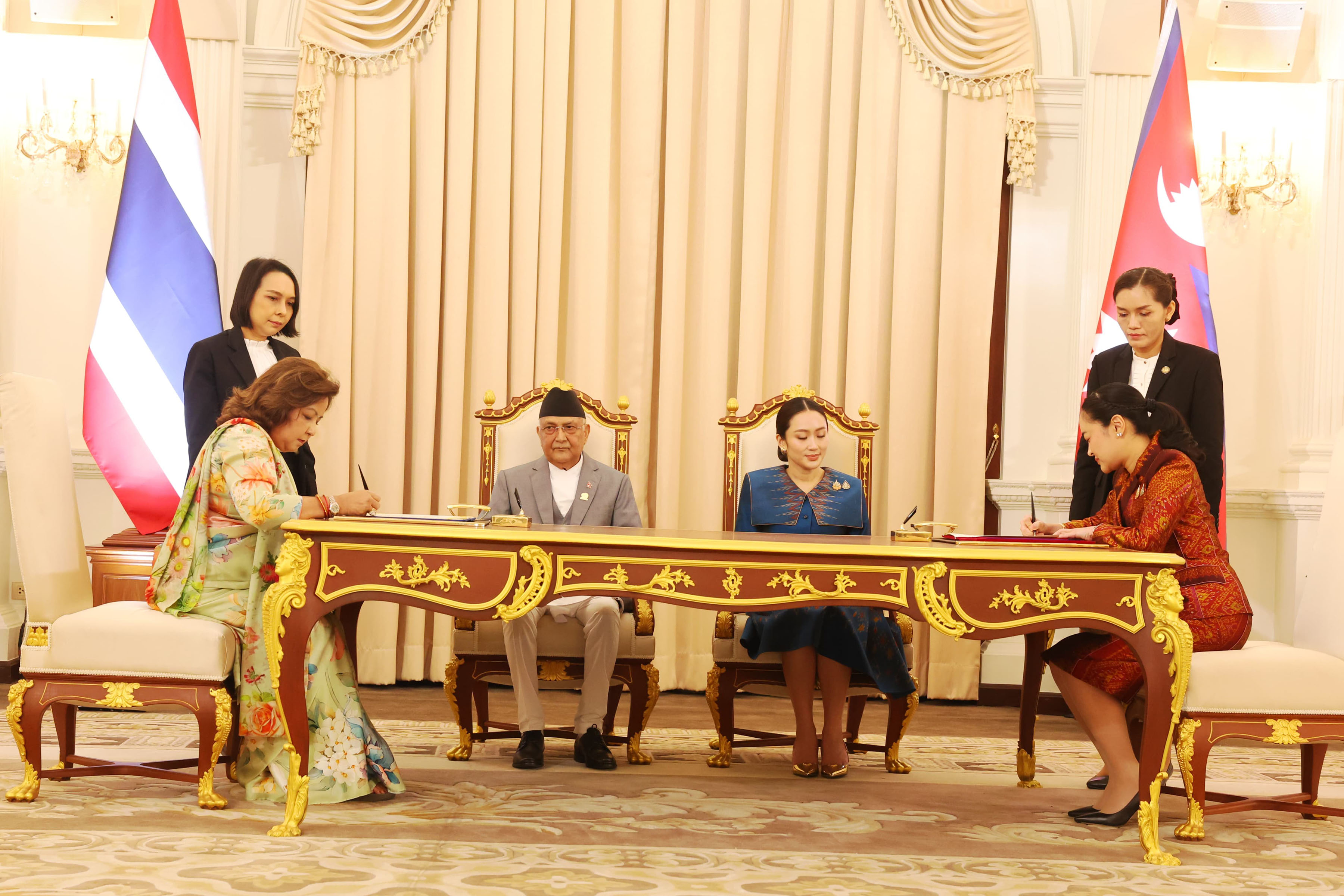
Nepal and Thailand ink 8 landmark MoUs to strengthen bilateral...





-1200x560-1784036910.webp)


