In Nepal, thrust has always been given to solidarity at all the levels. The Nepali model of solidarity is based on the pillars of spirituality, religious tolerance, social cohesion, human values and charity. Be it Hinduism or Buddhism, there is a common belief among the people that every action has reaction – good begets good and bad begets bad. This has strengthened the feeling of cooperation and social welfare at the national level.
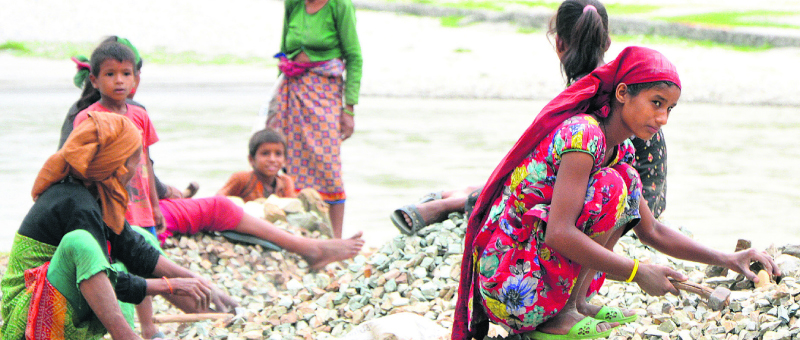
Yet, of late, there has been certain erosion in social and cultural values in Nepal. Each successive day, the tendency of individualism, consumerism, greed, violence, terror, selfishness and crime among different sections of the society has been growing. Also, there is decline in community feeling, misuse of drugs and alcohol, erosion of human values such as tolerance, honesty and compassion, family breakdown, poor parenting, gender inequality and rural-urban divide.
Inequality of income and opportunities among different sections of the society in Nepal has been well underlined in one of Asian Development Bank´s recent reports. It categorically pinpoints that inequality grew most over the years in Nepal.
Many of the problems – be it social, cultural, economic or political unrest –swell because of the unequal distribution of resources. Even terrorism at the global level has a tendency to thrive on unequal distribution of resources. As many as 40 to 60 countries with over 2 billion population in today´s world have been sliding backward mainly on this account.
Unfortunately, not much effort has been made globally for addressing the problem of unequal distribution of income and resources. The Helsinki-based World Institute for Development Economics of the United Nations University (UNU-WIDER) in its study has found that the richest 2 percent of the adults at the global level own over half of global household wealth. Rather, the richest 1 percent of adults has in their possession 40 percent of global assets. The richest 10 percent of adults have in their lot 85 percent of world’s total wealth. On the contrary, the bottom half of the world’s adult population own merely 1 percent of global wealth.
Wealth is unevenly concentrated in North America, Europe and high–income Asia-Pacific countries. People in these countries collectively account for world’s 90 percent of total wealth. Moreover, wealth is most unevenly distributed even within the countries. The top 10 percent of the population in a country like China hold 40 percent of wealth; whereas in the US this percentage stands at 70 percent.
In Nepal, it would not take much time to address economic mismanagement and transform conflict into peace if the government and stakeholders solidly resolve to improve the quality of human resources, promote capital formation and create environment for infrastructural development.
One of the reasons of over concentration of wealth is that a few so-called successful investors promote economic growth in complete disregard of millions of common people living mostly in the rural areas. An impression is created that the common people living in this part of the world are meant for creating overpopulation and that they are incompetent.
It is often forgotten that the greed to hoard more and more at the cost of the others is not in the interest of even the hoarders. The recession in the mighty economy of the US is its glaring example, which has thrown even the doughty American shoppers out of all the gears resulting into weakening of the labor market with higher unemployment rate. It is due to the greed of the banking and other financial institutions to go for undue profit that the problem of recession has occurred in the country.
In India, too, despite the GDP growth rate of 8.8 percent, there is a dichotomy of two India – one “haves India” and the other of “have-nots India.” The annual unemployment rate in the country is over 10 percent. And the people below the poverty line are accounted for 35 percent.
Be it in US or in India or so to say all over the world, most of the corporate sector bodies are cut off from the rest of the countries. Extravagance caused by corporate lifestyles has been responsible for the rise of ‘vulgar consumerism.’ It has added ‘costs’ and ‘inflationary pressures,’ which in turn has multiplied the economic miseries of the common people.
Coming back to Nepal, even the Maoist insurgency which took its roots in the Western hills of the country thrived mainly on account of unequal income and opportunities. And the present unrest that is perceptible in the Tarai region is also largely attributed to this factor alone.
Yet, opportunities are not all lost. It is not that difficult to save Nepal from further chaos if there is a will at certain level to bring positive change. Until 1965, economic development was minimal and corruption was rampant in Singapore. But under the capable leadership of Lee Kwan Yew, the GDP per capita of this tiny state picked up to US$26,000 - leaving even the country like Britain (with per capita income of around US$19,700) behind. Ireland happened to be the poorest country in Western Europe, but now it is one of Europe´s fastest-growing economies.
The southern US states such as Mississippi, Alabama, Georgia and Atlanta were not much developed until the early 1960s. But today they are on the forefront of economic development in US. Alabama has turned to be a global hub of economic activities. Georgia has emerged as 17th largest economy in the world. Not very far off, countries like India, China and Dubai transformed themselves from underdeveloped stage to world´s fast-growing economies within the last two to three decades.
In Nepal, it would not take much time to address economic mismanagement and transform conflict into peace if the government and stakeholders solidly resolve to improve the quality of human resources, promote capital formation and create environment for infrastructural development, apart from promoting the governance system through the improvement in law and order situation in the country.
This can be done when the scientists start contributing toward solving environmental challenges, doctors discover new medicines, engineers advance the society, entrepreneurs generate prosperity, educators lay the foundation for future generations and government works together to advance peace, prosperity and stability. If a country like India, China, Singapore, US and many others can transform themselves for the better, there is no reason why Nepal cannot develop. The only thing that is needed is solidarity among people and a will to develop the nation.
Writer is Executive Director of Centre for Economic and Technical Studies (CETS) in Nepal
dr.hbjha@gmail.com
Related story
Solidarity for Dr KC Alliance stages demonstration in support o...