“If you want to walk fast, walk alone, but if you want to walk far, walk with others” was the African proverb the outgoing COP17 President Maite Nkoana-Mashabane from South Africa quoted in her opening address to the 18th Conference of the Parties (COP) of UN climate body that kicked off in Doha a week ago. The cliché highlights the long-term importance of the outcomes of multilateral negotiations despite the process being difficult, drawn-out and tiresome. Negotiating a deal that consensually addresses the concerns of over 192 countries representing various stages of development including the biggest greenhouse gas emitters such as China and the US and the highly vulnerable but the least emitters such as LDCS and many small island states is not easy.
THORNY ISSUES
This year’s COP stands at crossroads. The first commitment period of Kyoto Protocol (KP) that came into effect in 2005 after it was adopted in 1997 ends this year, with little progress in its commitment of cutting global GHG emissions by at least 5.2 percent below 1990 levels by 2008-2012. A succeeding accord with clearly spelt out timeframe, number and ambition level is yet to emerge, though a broader consensus on its immediate extension with a legally binding text had been reached last year in Durban. It had been agreed in principle that such a deal would be struck by 2015 and brought into force by 2020.

PHOTO: AAP
There are many powerful countries including the US which never ratified the KP even after signing it, and Russia, Japan, Canada and New Zealand, which have pulled out from the regime arguing it would be meaningless unless the emerging nations led by BASIC countries (Brazil, South Africa, India and China) are also bound legally to reduce emissions. However, the BASIC countries assert that as per the principle of Common but Differentiated Responsibilities and Respective Capabilities (CBDR-RC) and equity based on “historical responsibilities” of the industrialized countries (known as Annex 1 as per the KP), they cannot be treated on equal footing as they should be allowed to “develop, though not at the cost of environment”.
COP18 is also restless about the safe and successful culmination of its two subsidiary bodies formed as AWGs (Ad-hoc working groups) for the long-term cooperative action (LCA) under the Bali Action Plan (BAP) during COP13 in 2007 and for the “further commitment for Annex 1 parties” under the KP in 2005 respectively. The concern as to how the unaccomplished or half-accomplished tasks on adaptation and mitigation assigned to these two streams of negotiation would be addressed by a new AWG on what is called the Durban Platform for Enhanced Action (ADP) that was created during COP17 is wide and worrisome, especially on the part of the developing and least developed countries. They are the ones who are most affected and vulnerable, and need, therefore, an easy and equitable access to finance, technology transfer and capacity development mechanisms at a scaled-up and sustainable basis.
Finance, in this context, is of critical concern to all in Doha. The Green Climate Fund (GCF) that was conceived in COP15 in Copenhagen in 2009 is finally an entity, to be housed in Songdo, Korea. But whether it will fulfill its promises to raise US $100 billion a year by 2020 as the predictable and sustainable long-term finance to the climate-vulnerable countries or will remain an “empty shell” is still a wild guess. The developed countries’ claim that they actually delivered US $30 billion “fast-start finance” (FSF) for 2010-12 as promised is disputed by many least developed countries because they suspect it has not been disbursed as full, fresh and additional finance. They believe the amount has rather been “recycled, loan-headed and doubly counted, and channeled through bilateral rather than multilateral windows”. The concern is that such funds are not sufficiently transparent (measurable, reportable and verifiable), the contributors are not taking the fair share as per their ‘responsibility’ and ‘capability’, funds have been tilted toward mitigation rather than adaptation against what was agreed upon, most of the money has not been debt-free, even for adaptation, and also not channeled through UN bodies as agreed.
Lastly and more importantly, far less than the pledged amount has been delivered. It is expected that Doha will chart a roadmap for a long-term (beyond 2020) as well as short- or medium-term (2013-15 or 2013-20) funding mechanisms in order not to create any gap after the FSF ends this December.
EXPECTATIONS AND POSSIBILITIES
UNFCCC Executive Secretary Christiana Figueres deservingly says she is positive about outcomes, though expectations run high. “As many as 45 issues are currently under discussion, and hopefully they reach a conclusion by the end of next week”, the Gulf Times quoted her as saying. Issues range from global to regional and sub-regional, involving a host of interests, concerns and priorities of the country-groups based on their region, geography and state of development and vulnerability. But what comes to prominence are issues such as the agreement on second commitment period (CP2) of KP with immediate effect embracing a ‘flexible mechanism’ even for those who would not stay within it; decision on agreeable mitigation work-plan with the raised ambition level for all countries before a new protocol in 2020; successful ‘safe-landing’ of two AWGs and agreement on the ADP that will bring in a new Protocol by 2015; and foreseeable capitalization and operationalization of GCF along with a stop-gap arrangement.
As happens in multilateral negotiations, agreeable outcomes on such critical issues emerge only towards the end of the conference when political leaders convene. But the needed groundwork has to be completed and climate has to be properly set before they meet. Doha is now intensely engaged in this process, with a series of parleys and consultations at various levels, both within and outside the UN negotiations framework. No one is sure about the results, but chances are high for a fair deal on the issues mainly surrounding those of KP2 and GCF, among others.
NEPAL’S POSITION
Nepal’s participation in COPs is increasingly qualitative and focused, though still far from being influential based on its strength alone. We are one of the 48 LDCs working within the LDC coordination group that negotiates with many other groups within the negotiation framework. Both as an opportunity and challenge, we are taking over from Gambia as LDC chair for 2013-14, and Doha is a platform for us to prove that we were worthy of this feat. The country delegates, playing their designated roles of the official Party and observers, are visible, heard and acknowledged in their respective meetings and forums including side events. The government’s recent formation of the Core Negotiating Team, consisting of non-government experts and practitioners as well, was a step in that direction, and allocation of responsibilities based on their interest and expertise further added vigor to the team performance. Standing on the two platforms of LDC chair and the Mountain Initiative, reflected in the 10-point Kathmandu Call for Action adopted last April, Nepal is ready to reap benefits of climate negotiations.
Nepal’s position on climate issues does not stand alone in UN negotiations, rather we present and defend our views through the LDC group and try to win their support. We have been consistently following the LDCs position and putting forth our views both within the group and in other meetings. Our status is distinct because, besides being LDC, we are a mountain country also, meaning our vulnerable mountain ecosystems need more protection with added investments in optimizing mountain potential such as water, agro-ecology, biodiversity, energy, cultural treasures and other resources.
Nepal can and should lead the LDCs and mountain countries on climate change with a dedicated, competent and motivated national team.
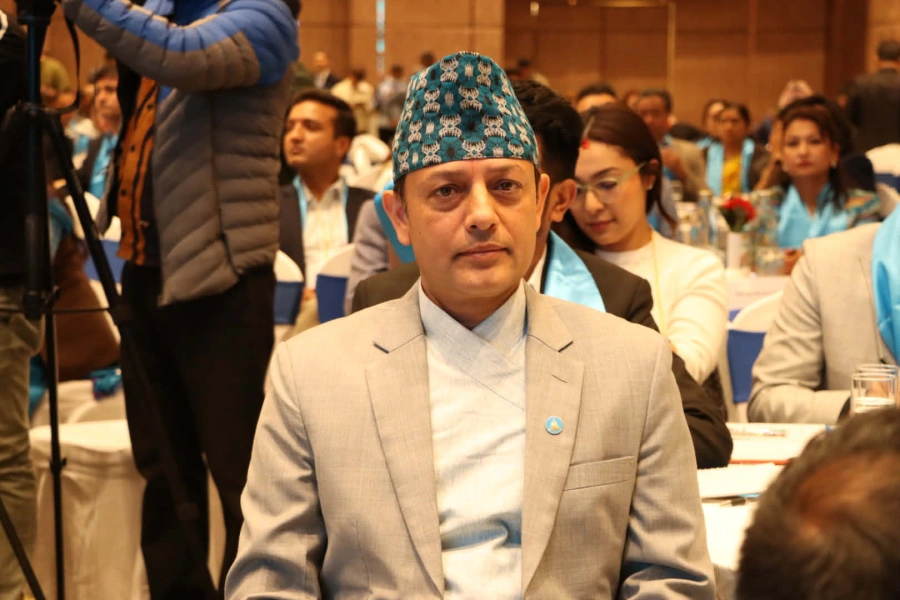
The author is former environment secretary now in Doha as a COP18 delegate from Nepal
Related story
SHIFT for Our Planet: Youths urge authorities to make climate j...