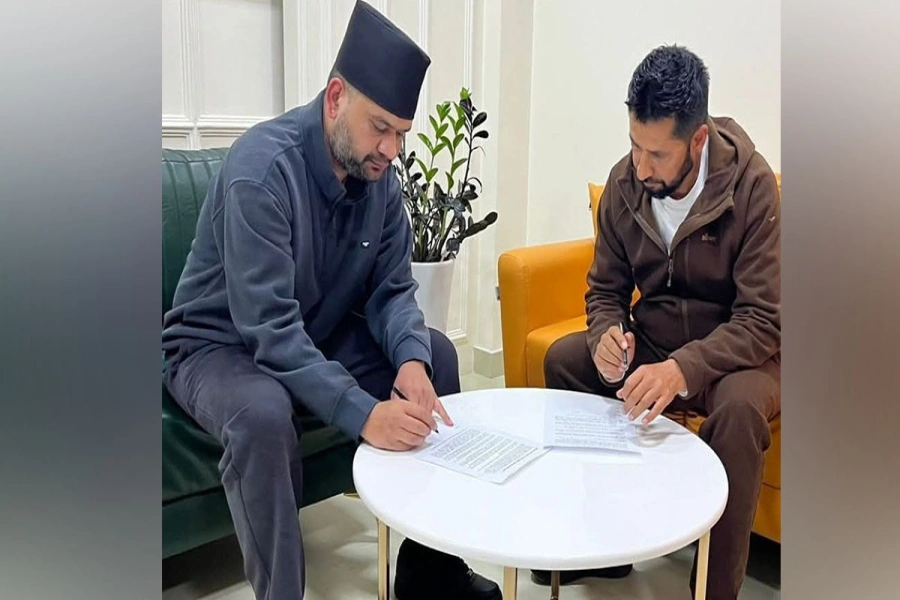
The entry of Kathmandu Mayor Balendra Sah, or Balen, into the Rastriya Swatantra Party (RSP) as a second-ranked leader has left many bewildered. This is because Balen has, over the past three years, emerged as a potential youth leader who could have set up his own party and led it to victory in national politics. After he and RSP chair Rabi Lamichhane inked a seven-point deal paving his entry, the possibility of Balen leading his own party ended, raising questions about what made him opt to be a second-ranked leader in a party that has lately been ridden with internal tension and a sharp decline in popularity. The party chair is struggling with legal issues over his alleged involvement in cooperative fund embezzlement, which could cost him his political career. Many say some external forces have brought these two youth leaders together, while others say the RSP’s decision to make him the party’s prime ministerial candidate is the main reason behind Balen’s surprise entry into the RSP.
The Kathmandu mayor’s surprise move, however, has generated considerable buzz across the country. Balen’s entry has definitely given the RSP an edge at a time when the nation is heading to the polls in two months. The rapper-turned-mayor has the potential to attract young voters, as was evident when he won the mayoral seat by a wide margin. With his relatively clean image, he could be a major attraction for voters disgruntled with the current crop of leaders. The unity could give several groups of Gen Z youths a reason to celebrate.
Indeed, the announcement of Balen as the prime ministerial candidate represents a calculated step to project a united face of the RSP. It presents voters with an option and helps differentiate the party from other “traditional” parties with aging leadership. In the larger political context, the unity is an attempt to channel the energy of the Gen Z movement through institutional politics. The alliance emphasizes ideals such as social justice, governance, and pluralist democracy, hoping to win votes for change and integrity. On a different note, the merger has brought Mayor Balen into the RSP while keeping all emblematic symbols and the party structure intact.
RSP hatching strategy to end Balen’s politics from Jhapa: UML J...

The RSP now needs to accommodate Balen’s followers at the national, regional, and local levels. This could result in possible tension during candidate nominations and leadership selection. The inclusion of prominent leaders with recognizable public profiles has often been a source of tension within Nepal’s political parties. The country’s political history has already demonstrated the risks associated with such inclusion, as seen in the rapid downfall of the Nepal Communist Party due to differences between KP Sharma Oli and Pushpa Kamal Dahal.
Many believe this unity will automatically weaken the Nepali Congress, CPN-UML, and the Maoist Center. This, however, is not entirely accurate. While the Gen Z movement and calls for generational change have led to some decline in support for older parties, their influence has not weakened to the extent that they no longer remain key decision-makers during elections. The announcement of Balen as the RSP’s prime ministerial candidate does not necessarily represent a winning combination for the alternative forces in the general election. Balen may win in his own constituency, but there is a significant difference between success in a single constituency and securing votes nationwide while competing against deeply rooted support bases of established parties. It is akin to winning a battle but losing a war.
Balen and his supporters must also recognize that the RSP has problems of its own. Allegations of misusing cooperative funds and passport-related cases have long loomed over Chair Lamichhane. He spent several months in prison and has also been accused of inciting a jailbreak during the September 8–9 Gen Z protest. Due to internal bickering, key leaders, including Sumana Shrestha and Santosh Pariyar, left the party while the party’s general secretary Mukul Dhakal was unceremoniously expelled for demanding internal reforms. Toshima Karki, another well-known party face, has also reportedly expressed dissatisfaction with the party’s functioning style. It is evident that welcoming a new face as one of the highest-ranked leaders may not resolve internal rifts. Such divisions could undermine the recent unity. Moreover, Lamichhane’s legal troubles may continue to generate skepticism. If these issues persist during the election phase, voters may question the credibility of the alliance. While voters may admire Balen, continued legal problems faced by Lamichhane could weaken the partnership. Many believe Balen would struggle to defend Lamichhane if the latter faces imprisonment due to cooperative-related cases.
It is true that the unity between the two leaders has challenged conventional political parties at a time when they are preparing for the March election. The Nepali Congress, UML, and the Maoist Center have long relied on hierarchical, personality-driven leadership and alliances. However, the emergence of a youthful and collective political alternative now compels them to reassess and realign their political strategies, plans, and campaign methods, including the possibility of new alliances.
To sum up, the Balen–Rabi unity is a significant political development, but it does not render established parties irrelevant overnight. It offers a fresh face, renewed public interest, and a clear pre-election leadership signal. Still, the RSP faces internal challenges, Lamichhane has ongoing legal troubles, and Balen has yet to demonstrate nationwide electoral influence, leaving the party with an uphill task of winning a majority. This alliance could reduce vote fragmentation and put older parties under pressure, but the election outcome will ultimately depend on how well the RSP manages its internal problems, shapes public perception, mobilizes its cadres, and attracts voters.