

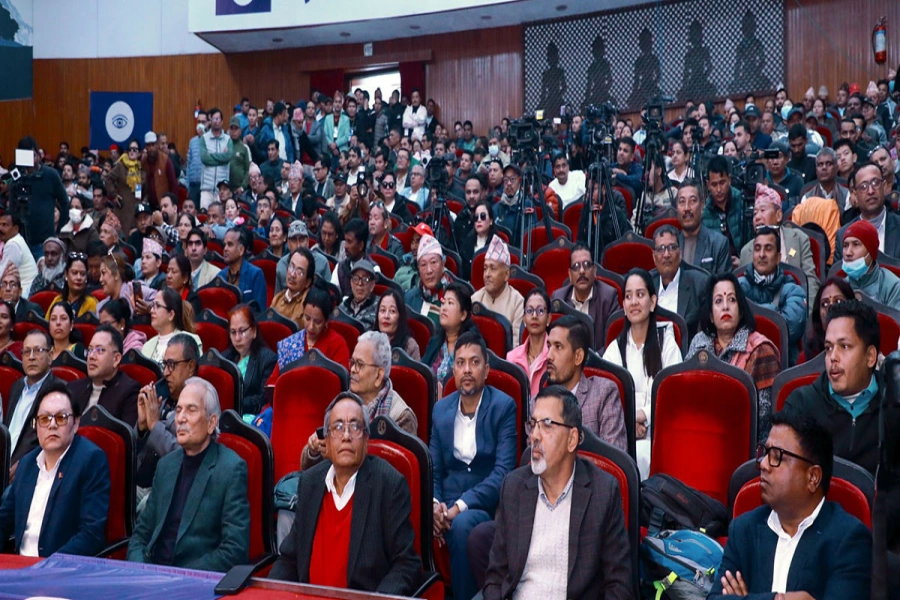
KATHMANDU, Nov 24: Progressive Democratic Party (PRD) was formally launched in Kathmandu on Sunday, bringing together several prominent figures from former Maoist and socialist factions and positioning its guiding ideology as a refined form of Marxism.
The new party emerges through the initiative of Nepal Samajwadi Party (Naya Shakti) coordinator Baburam Bhattarai, former Maoist leaders Janardan Sharma, Ram Karki and Sudhan Kirati, as well as former Rastriya Swatantra Party chief whip Santosh Pariyar, among others.
At the announcement event, Sharma presented a brief document outlining the party’s political commitments. The document includes a concise review of the recent Gen Z uprising, concluding that the movement erupted in response to political parties’ cultural decay, entrenched bureaucratic stagnation, rampant corruption, nepotism and the perpetual “musical chairs” struggle for state power.
According to the party’s initial charter, the events of September 8 and 9 became historic as Nepal witnessed a dramatic change of government within roughly 40 hours—driven entirely by the momentum of young protesters.
Far from progressive

PRD identifies three core triggers behind the uprising: the demand to end corruption, the reopening of banned social media platforms and the transformation and generational renewal of political parties. The party argues that what began as a peaceful movement ultimately escalated into an uprising after the state resorted to excessive suppression.
Positioning itself against this backdrop of political upheaval, PRD states that a new political initiative has become essential to channel the Gen Z movement, protect the sacrifices of past political struggles and prevent their legacy from being lost.
Its declaration outlines priorities such as cultivating young leadership, amplifying youth voices, ensuring good governance, restructuring political and state institutions, promoting science and technology, generating employment and establishing an accountable system to achieve prosperity within a defined timeline.
The party also underscores the need to honor the legacy of Nepal’s past movements—from the People’s Movement and the Maoist insurgency to the Madhesh, Tharu, Janajati, Dalit struggles and the Gen Z uprising. The document asserts that PRD aims to unite Gen Z youth, students, intellectuals, progressive forces and democratic left groups into a collective capable of driving rapid national prosperity and building a strong, inclusive state system for a prosperous Nepal.
Addressing the unity declaration event at the City Hall, Sudhan Kirati emphasized that the party is not being formed merely to add another display in Nepal’s crowded political landscape. He said the new party will not replicate a hierarchical structure where “one master sits on the stage and thousands of devotees sit below.” Instead, he argued, the goal is to serve the people and develop leadership grounded in ideas and solutions. He noted that the party seeks a leadership culture focused on addressing real problems with disciplined political methods.
Similarly, Santosh Pariyar—who left the Rastriya Swatantra Party to join the progressive democratic alliance—acknowledged that the path ahead will not be easy.
Speaking at the launch event, he said that although the journey is difficult, the current generation does not have the luxury of choosing comfort over responsibility. He emphasized the need to combine the experience of older generations with the energy and urgency of Gen Z.
Calling for a broad progressive unity, Pariyar warned that avoiding responsibility in this moment would leave future generations to condemn today’s leaders as dishonest and cowardly. “This is not an easy path,” he said, “but we do not always get to choose the easy one.”




-1782782519.webp)


-1200x560-1774606010.webp)


