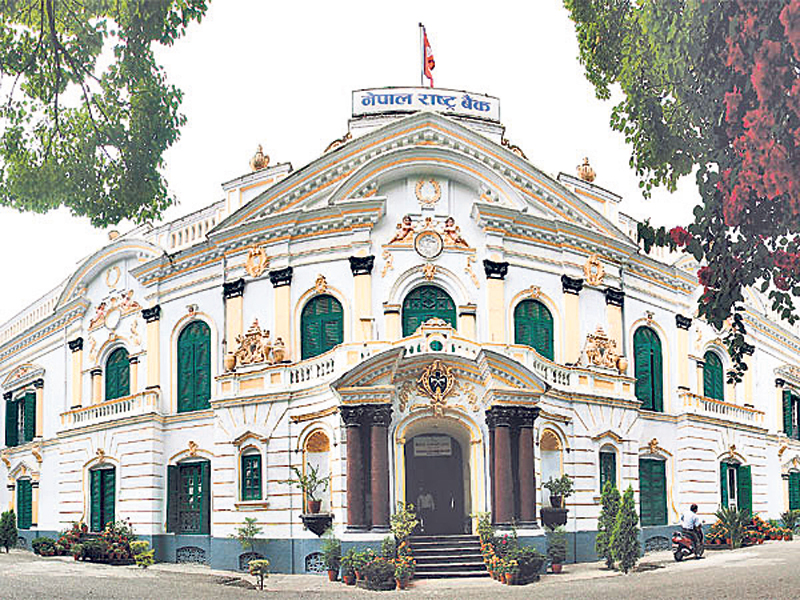
The central bank decided to make deposit insurance compulsory mainly after BFIs continued to cold-shoulder the government´s call to safeguard small depositors´ savings voluntarily.[break]
To start with, the central bank will make the scheme compulsory for the development banks, finance companies, micro-finance development banks and co-operatives only.
“It will later be made mandatory for commercial banks as well,” said a central bank source.
NRB has already initiated steps to build database of people that have deposited up to Rs 200,000 million in savings and fixed accounts in the financial institutions. It has further asked the financial institutions of Category B, C and D to furnish number of clients saving up to Rs 200,000 and also the total volume of such small deposits to Deposit Insurance and Credit Guarantee Corporation (DICGC) -- the state owned insurer.
“Such database will give us a basis to implement the insurance. By that time, we also expect the government to execute restructuring of DICGC to kick-start the program,” the source said.
Currently, financial institutions, including development banks, finance companies, micro-finance development banks and co-operatives, have mobilized well over Rs 165 billion from the public. Of that, the central bank estimates the volume of small deposits (up to Rs 200,000) to be worth around Rs 20 billion.
“Basically these savings belong to low income groups. And the scheme, once into implementation, will guarantee that they will get back their savings even if the financial institutions go bust,” said the source.
The central bank´s latest push for deposit insurance has come at a time when experts have been expressing wariness over possible adverse impacts of real estate crash on the financial system.
It is not the new scheme though. The government had announced it in the budget for 2009/10, mainly after the collapse of Nepal Development Bank (NDB). Its implementation, however, had hit snag mainly because of poor financial health of DICGC, the proposed insurer, and lack of clear operational strategy.
“But we now have Deposit Insurance Bylaw, which lays down a clear modality on the implementation of the insurance,” said Chandra Man Maleku, general manager of DICGC.
According to the bylaw, BFIs that are not declared as troubled institution can buy insurance for their clients with savings and fixed deposits up to Rs 200,000 at the rate of 20 paisa per Rs 100. If the client BFI went bankrupt and liquidated, the corporation would safely refund money of the depositors within 90 days of the submission of depositors´ list by the liquidator.
Apart from that, the government has also endorsed a plan to raise DICGC´s capital to Rs 2 billion in order to build its capacity to shoulder the new liability. It has even allocated Rs 250 million as seed money to build the compensation fund of the corporation.
The corporation will soon undergo major overhaul in its stake too. Maleku said the government will have 90 percent stake on the corporation, while the rest would be held by Nepal Rastra Bank.
Currently, the government holds 45.98 percent stake followed by Nepal Rastra Bank with 47.12 percent, Nepal Bank Limited with 4.6 percent and Rastriya Banijya Bank with 2.3 percent.
Related story
Election deposits of nine candidates, including one from UML, c...