Nepalis are accustomed to political instability—we braved 10 years of Maoists’ War and have shown great resilience in the face of lingering political instability even now. But many of us don’t have a fresh memory of living under economic instability, mainly caused by macro-economic imbalances.
To live under poverty and to live under unstable economic times are two different things. Poverty is caused by low level of economic equilibrium—where saving is low and so are investments, outputs and consumptions. It brings hardship but it does not bring a great deal of uncertainty. Just think of a subsistence agriculture where people produce little and eat and live on what they produce.
The economic crisis that is in the making may not seem as severe as the past one, but make no mistake, it’s a much more complicated one because our economy is no longer as simple as it used to be in the early eighties.
But economic imbalance brings both uncertainty and pain—it often forces, and that too very suddenly, to dramatically alter their way of living. Last macroeconomic crisis that Nepal faced was in the early eighties. Following the Keynesian prescription (that the state must make massive investments to boost economic growth and jobs) the government of the day heavily borrowed from the banking system and invested in the economy. But the supply side of the economy wasn’t strong enough to respond immediately. The result: Both the prices and imports grew. Inflation rates shot up and the Balance of Payment (national account of inflow and outflow of income) was soon in the red. At one point, Nepal had a foreign currency reserves just enough to finance imports for less than one-and-a-half months.
The economic crisis that is in the making may not seem as severe as the past one, but make no mistake, it’s a much more complicated one because our economy is no longer as simple as it used to be in the early eighties. And if not handled properly, the early signs of economic imbalances could grow into a full-blown crisis. In the early eighties, it was also easy to manage the crisis—it was, after all, a controlled society where a strong centre could restrict both the flow of information to people and their response to the impending crisis. No longer.
What’s the current imbalance? During the first quarter of the fiscal year 2009/10, our foreign exchange reserves dwindled from 224 billion rupees equivalent of foreign currencies to 198 billion rupees. It means, on an average, we lost about 8-9 billion rupees equivalent of foreign currency every month and our foreign exchange reserves can now sustain imports for just seven months. The officials at Nepal Rastra Bank and Finance Ministry are worried because if the trend continues for a long time, Nepali economy is doomed.
The current reverse flow of foreign exchange in the first quarter of the fiscal year is triggered by three things – slow growth in remittance inflow (11 percent), robust growth in import (30.4 percent) and negative growth in export (minus 16.8 percent). Till now, we were basking in the high rate of remittance inflow that offset out trade deficits. As the remittance flow fell short of the trade deficits, our economic worries have reappeared. The compounding factor this time was also a relatively low flow of grant money provided by bilateral and multilateral donors.
Just take a pause here to think this: What is holding our economy? It’s the money earned by poor Nepalis working abroad shedding blood, sweat and tears and the alms (foreign aid is just an euphemism) given by the donors.
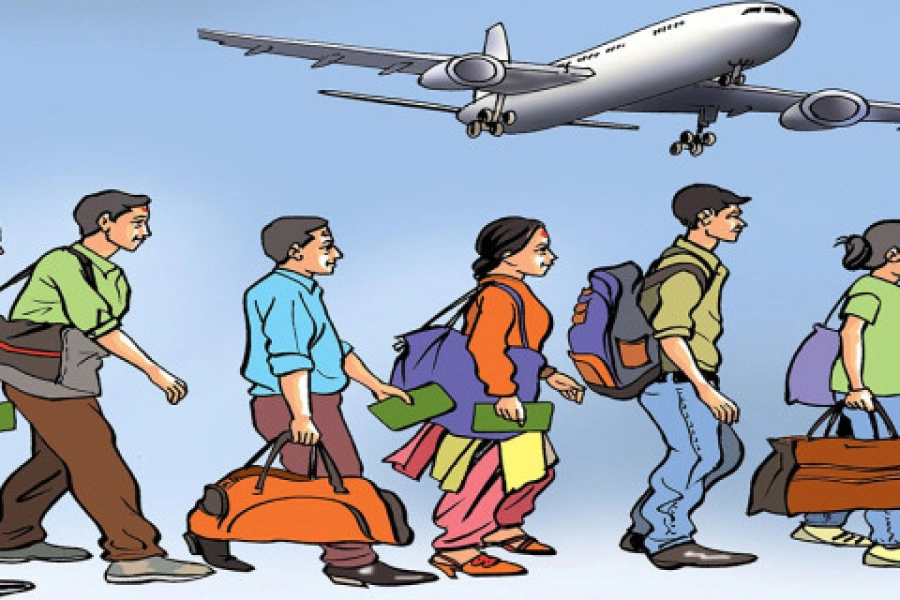
We have so fast become a remittance economy and there is nothing wrong with it because Nepalis working abroad bring in money, skills and work culture. More and more Nepalis will go abroad for jobs and this trend will accelerate as China and India continue to grow at a high trajectory. But to rely on remittance alone means tying our fate permanently to the economic ups and downs of other countries. We should, therefore, give up our remittance-fed complacency and get to the task of rebuilding our economy with a decent export-base.
There are short- and long-term measures that we can take up to arrest the early signs of current economic troubles and our prolonged problem of economic stagnation.
One reason why our imports have grown at such an alarming rate in the first quarter of this fiscal year is explained by high import of gold (225 percent; net amount Rs 14.9 billion), purely to re-export it to India taking advantage of differentials in the tariffs between the two countries. The government should immediately revoke the stupid tariff policy on gold and bring it at par with Indian tariffs. Discouraging unproductive investment on gold is likely to bring down the second quarter trade deficit at least by about 10 billion rupees.
Our long-term challenge, however, lies in building our export base. Just go through our export items (and the corresponding monetary returns) and it will cast a depressing outlook for our economy. In the first quarter of this fiscal year, our largest export to India was polyester yarn (net amount Rs 993 million) and to the third country was pulse (1.9 billion). Carpets and garments, whose joint export figure once exceeded 25 billion rupees, have come down to 2 billion rupees in the first quarter and both of them registered a negative growth rate of 36 and 24 percent respectively. Our industrial and export base is where it was some 40 years ago.
In the absence of industrial growth and investment opportunity, our banking system has diverted its investments in realty market, apparently overheating it. Once addicted to the easy profits, banking sector will find it hard to look for long-term, productive investment opportunities. Easy money often kills creativity and innovation. There are two ways in which we can build our export-competitiveness. In the long-run, we must generate enough electricity and provide dependable power supply at an affordable rate to the manufacturing sector. Geographical proximity of Nepal’s southern plains with enormous markets in Bihar, West Bengal and Uttar Pradesh of India will attract a lot of investors in Nepal.
The short-term measure is to end the political instability, reform and offer predictability in our tax and tariff regimes and other governing laws and create a healthy industrial relationship between the laborers and factory owners. If we can ban labor strikes in industries, it’s going to bring in more investment from India and third countries. More industrial investment means more factories, more jobs and higher pays. Fair competition in the labor market can give laborers what collective bargaining can’t.
If we can’t promise dependable power supply and stable labor market (guaranteed by stable politics), there is no third variable on which we can build our export-base.
While in power Maoist leader Baburam Bhattarai said he was for banning strikes but once out of power United National People’s Movement, Nepal, led by him announced a three-day long general strike. Only last month Barun Beverage, the bottlers of Pepsi Cola in Nepal, announced the shut-down of its factory due to strike by Maoist-affiliated trade union. Many other Indian joint-ventures have already rolled back their investments from Nepal.
Our short-sightedness is the surest way to aggravate the early signs of our impending economic crisis.
ameetdhakal@gmail.com
Related story
Lady Gaga releases new music video 'Stupid Love'








-1781762832.webp)