

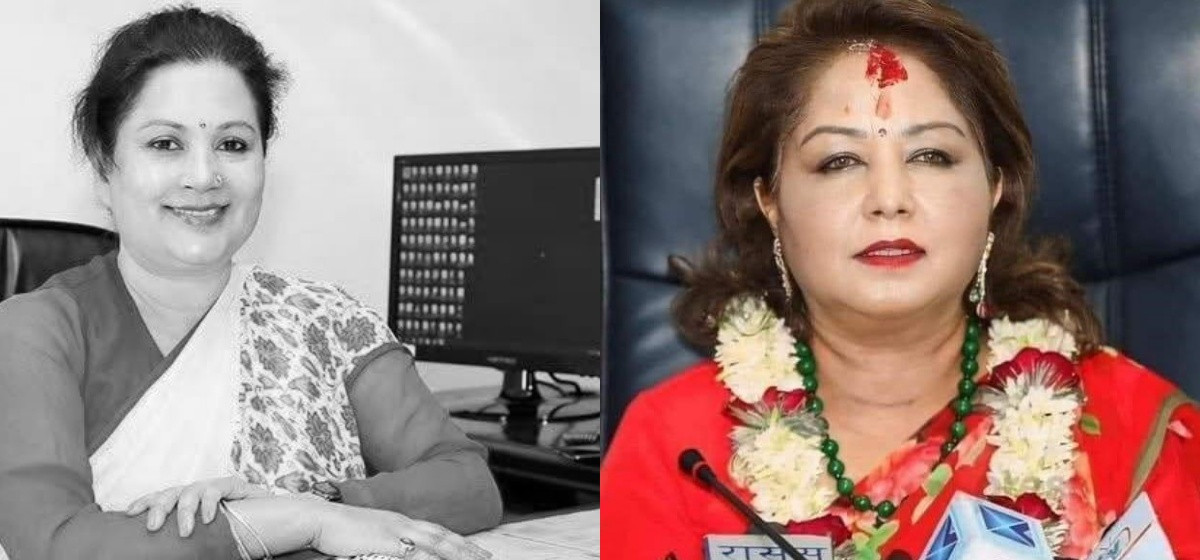
Sharma has always been in pursuit to make a difference and has strongly advocated women’s rights and issues. Born and brought up in Varanasi in India, she later came to the capital to continue her education and career. She worked for thirteen years at The Rising Nepal as news desk editor where she also wrote editorials on wide range of topics like gender, politics, development and legal issues. She also worked as a TV anchor for Arthko Arth, a weekly business and economy news program aired by Nepal Television in1993.[break]
The Week talked to Sharma about her journey into journalism, women in the media and more about her challenges as Election Commissioner.
Dipesh Shrestha
How did you get into journalism?
There wasn’t a center for TOEFL exams in Varanasi, so I came to Kathmandu for it to study LLM in the US. My future brother-in-law was in journalism and he suggested that I apply for a diploma course offered by Nepal Press Institute. We were the second batch who joined the nine-month course and later I interned at The Rising Nepal. My editor back then, Shyam Bahadur KC, asked me to apply for a job as there was a vacancy and that’s how it all started when I was just in my early twenties.
How was it like to practice journalism back then?
It was during the Panchayat era, so challenges as such were different than today. The Rising Nepal was the only daily broadsheet in English during that time. It was a different time because journalists in English newspapers were appreciated more than their Nepali-language counterparts. Our salary and levels were also higher as compared to the journalists working at Gorkhapatra which was the only daily Nepali broadsheet.
What were the challenges for being a woman journalist?
During my thirteen years at the Rising Nepal, there were very few women in journalism. There were hardly two or three women who came and left, and sometimes I would be the only female there. I believe I contributed to the cause of women journalists in my own way, and anyone in my place would’ve done the same thing if one stayed long enough. Like many women journalists who must’ve faced the same thing in their career, I was told to do soft stories as soon as I was employed, which included covering culture, fashion and even stories on children.
The most serious stories that I was assigned were to cover crime. I was interested in covering politics and I used to wonder why I wasn’t asked to do so as I hadn’t understood Nepal’s environment that well. I think my then boss P Kharel had been instrumental in helping me to advance my career in journalism as he encouraged me to write editorials. Though I was apprehensive, I started writing editorials regularly. In a newspaper house, if you write editorials, you’re accepted as capable and that’s when I think my colleagues started accepting me as equal.
How did you manage your work as a consultant lawyer and journalist?
I still wanted to pursue LLM, so I completed it from TU when my husband was still alive. I was in the first LLM batch and after that I practiced corporate law in a firm for four years. I balanced my jobs as a corporate lawyer and writing editorials. Both fields were similar to me as it was all about using words. When you’re a consulting lawyer, you’re mostly doing contracts and not litigating. So it was more of meeting clients and drafting contracts.
How do you feel about your new responsibility as Election Commissioner?
I think it’s like you’re on the other side of the fence. The good thing I believe is that the current composition of the Election Commission is perfect as all four of them come from bureaucratic background and have diplomatic experiences as well. On the other hand, I come from the other side and have a journalism background. For me, I’ve seen all of it as a journalist and not as a part of it. But it’s not so unfamiliar. This bureaucratic culture of the Commission, how people speak, and all of that are very different from journalism culture. But I think I understand what that’s all about because I’ve been watching the same milieu as a journalist for the last twenty years.
It’s a huge responsibility. I think all Commissioners are very committed to the upcoming elections. When you’re given a responsibility and something as big as this, you naturally feel responsible to your position.
How important do you think is women’s role in media and what are the challenges?
I think it’s very encouraging as many women are in media these days. I think women should be given opportunities and encouraged to start from the beginning as reporters so that in the next five to ten years they get to the position of chief editors as well. In that way, no one can accuse them of being a wallflower who didn’t deserve the position. I see so many women in electronic and print media, and in the next few years, there will definitely be some positive changes. I think women have more compassion, resilience, empathy and patience which are why they can rise to any occasion. Women should know that these are their strengths and then there’s nothing to stop them.
What do you think about the political situation of the country?
Nowhere in the world is politics stable, most especially in a country like ours that has a history of conflicts. My opinion is divided when I think about why [the last] conflict happened because I don’t think the People’s War was justified at all. But we have to accept the fact that the conflict happened, as a result of which there’s so much displacement, divisions in the society, and aspirations to be addressed. The People’s War was a selfish act which we can’t undo.
I think every citizen should be aware about the political situation of the country. Perhaps this sense of duty comes from the fact that the Rashtriya Nepali Congress was formed in our house in Varanasi. So it must be in my genes. My involvement hasn’t been direct as a party worker or cadre with any party. However, I was very involved as a citizen even during the Jana Andolan II. I was out on the streets everyday supporting the processions.
What are the current challenges?
All the Election Commissioners share the same challenges, as we have to ensure that the elections take place, that the elections are free, fair and credible. We have to maintain the dignity of the Commission and have to work in the interest of the nation. That’s one challenge that all the five Election Commissioners face.
Related story
FM Rana mourns over demise of former EC commissioner Ilaa Sharm...








-1200x560-1774606010.webp)


