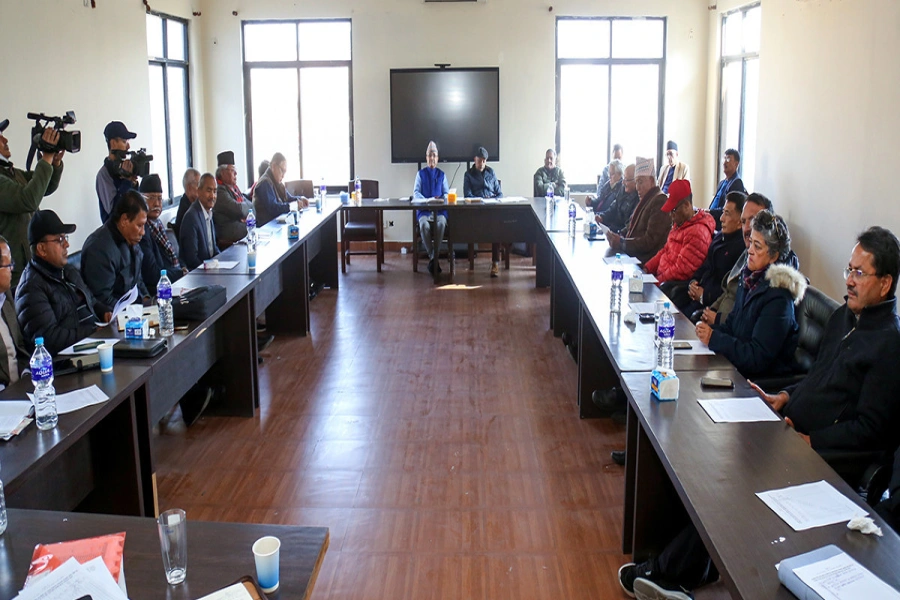
On the opening day (March 4) of its three-day-long meeting of the National Representatives Council, also referred to as a ‘mini’ General Convention, the CPN-UML staged a massive rally in the capital. The events were an exercise in confidence building for the cadres who were disappointed and confused due to the bitter ideological, factional and personal intra-party feuds. Divided leaders tried to portray that they were now one and the party will succeed in reviving itself and moving up from the third position it currently holds in the national polity. For outsiders, especially the Maoists, the message was that the UML will now play a more interventionist and assertive role in determining the political direction of the nation that includes the peace building and constitution drafting exercise.
RHETORIC AND REALITY
The mood in the rally was clearly anti-Maoist, a reflection of their suffering at the hands of the latter. Censure of the Maoists by a leader in his speech was greeted with gleeful applause. Chairman Jhalanath Khanal, friend-turned-foe of the Maoists, criticized the ex-rebels, albeit not as strongly as other leaders like Madhav Nepal, KP Oli or even Ishwor Pokharel. And although perhaps untimely and unwarranted, he could not repress his temptation to censure the Nepali Congress (NC) – the main political rival of his party for a long time, but now a partner in the peace process. Similarly, his sarcastic remarks on democracy reminded one of his communist schooling that is typically cynical of liberal democracy.
On the other hand, senior leader Madhab Nepal rightly stated that Maoists were constantly delaying the peace process (which is mainly because of the latter’s internal party politics) on some pretext. He urged people not to make broad generalizations such as ‘sabai ustai hun’ (all are equally guilty), given there is a distinction between those who want to conclude the peace process and those who use it as bargaining chip for political and strategic gains. While peace building and constitution drafting are the most crucial agendas of the country today, one cannot really blame the NC for the delay. The party may have a thousand shortcomings but it has never harmed anybody except itself.
The NC does not hold the key to the peace process. It does not have a private army in the process of being integrated into the national army. It is therefore not NC, who in this regard, is asking for newer and greater concessions than the ones previously agreed upon.
If UML is to survive in the present and plan for the future, it must admit that while NC is its political contender, UCPN (Maoist) is its ideological rival.
Both in his speech and the paper presented to the delegates of the meeting, Khanal spent considerable space criticizing the NC as yathasthitibadi (anti-change or pro-status-quo). At this delicate turning point in the history of Nepal, Khanal is indulging in characteristic communist self righteousness instead of producing a specific roadmap for the party or a blueprint for the federal structure of the country. Can Mr. Khanal explain in clear terms which socioeconomic program put forward by UML was opposed or obstructed by NC? Has NC ever stood against the uplift/liberation of Dalits or Women? Are there sharp differences in the land reform policies of NC and UML? Is UML’s economic policy against private sector and foreign investment? If no, what is yathasthitibadi about NC?
RETURN TO SYMBOLISM?
Earlier, UML leaders used to clench their fists to greet. But not anymore. These days, whenever some cadre member says ‘Lal Salam (Red Salute)’ with clenched fists, the embarrassed leaders respond with a cool ‘namaste’ instead. But this time in Tundikhel, things were different. Except KP Oli, most of the senior leaders, including Madhab Nepal, greeted the crowd with traditional clenched fists. Such symbolic gestures, however, were received with little enthusiasm by the crowd.
Other symbolic acts further added to the confusion about the party’s goals and methods. For instance, the policy of printing photos of only three national communist leaders (Pushpalal Shrestha , Madan Bhandari and Manamohan Adhikary—all moderate communists of their time) in all party literature was maintained this time as well. In all the posters, pamphlets and publicity materials of the rally, the traditional policy was followed. However, the reappearance of pictures of ‘Marx, Engels and Lenin on the big banner on stage seemed surprising.
Meanwhile, the rally was organized on March 4—the day when security forces killed five communist rebels in Sukhani in eastern Nepal four decades ago—and the event was remembered by the leaders who paid rich tributes. What, however, they chose not to mention was that it was also the day when a large chunk of the party split to form a new communist party 14 years ago, alleging that UML had betrayed those ‘martyrs’. Most of those who formed the new party—CPN-ML—later defected to the Maoist camp. Bama Dev Gautam, the leader of the breakaway group and a trusted Maoist ally for long, was one of the few that returned to the UML and remains there amidst widespread suspicions and allegations of a divided loyalty.
PAST, PRESENT AND FUTURE
CPN-UML is now a bourgeoisie political party rather than a communist or ideological one, irrespective of its history. Madan Bhandari—the far-sighted party general secretary—introduced ‘People’s Multiparty Democracy’ (PMD) that was adopted as the future political course of the party by its 5th General Convention in 1992. Notwithstanding the communist jargons and lengthy explanations meant for the consumption of the more radical cadres, the crux of PMD was to ultimately transform the party into a social and democratic force. PMD, therefore, was cautiously introduced as a test case and Bhandari’s plan was to release its advanced versions in the days to come.
But his untimely death left the entire program hanging fire. His inept successors (such as Chairman Khanal, who was a political rival of late Bhandari and who presented his own theory, rejecting PMD), who were either unable or unwilling to further define and chart the course of PMD, led the party to all sorts of self-contradictions and power-oriented opportunism in the name of transformation. Thus, the party could neither fully transform into a democratic party nor could it save its communist identity and constituency as the Maoists kept making inroads, becoming the number one political and communist force of the nation. Moving like a pendulum between UCPN (Maoist) and NC, it is now without any adequate role or an appropriate agenda.
However weakened the Maoists might be due to their greed and internal friction, they are still strong enough to have seized and retained UML’s traditional support base that comprised of the poor and the working class. UML’s support base has now shifted to educated circles like professional groups, where NC will be its principal contender. If UML leaders are to survive in the present and plan wisely for the future, they must admit that while NC is their primary political and electoral contender, Maoists are their ideological rivals. It is time the CPN-UML leaders, including Mr Khanal, get rid of all their confusions and contradictions, including the inconsistency between their communist schooling and democratic practice.
jeevan1952@hotmail.com
Related story
Head held high