


Nepal's public debt has reached Rs 2.974 trillion, equivalent to 45.07 percent of the country's gross domestic product (GDP). During the last fiscal year alone, the government added Rs 385 billion to its debt stock. Although it had planned to borrow nearly Rs 596 billion, it secured only about three-quarters of that target. Repayments and foreign exchange adjustments reduced the net increase, but the overall debt burden still rose sharply. More than half of Nepal's outstanding public debt now comes from foreign loans, with the remainder financed through domestic borrowing. A closer look at the figures reveals another concern: while the government nearly met its domestic borrowing target, it secured less than 38 percent of its foreign borrowing goal, forcing it to rely heavily on the domestic market. Debt servicing is also becoming an increasing burden. Nepal spent more than Rs 411 billion on principal and interest payments during the fiscal year, equivalent to 5.85 percent of GDP. Every rupee used to repay debt is a rupee unavailable for schools, hospitals, roads, irrigation and other public services.
Public debt hits Rs 2.8 trillion mark
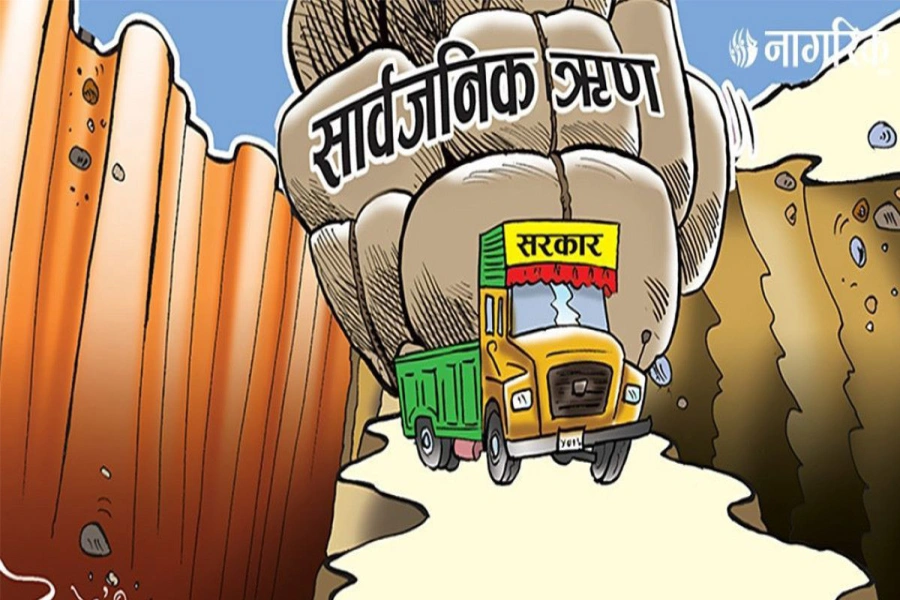
Debt, in itself, is not a problem. Every country borrows. The real question is whether borrowed money generates enough economic value to repay the loans. If loans finance productive infrastructure, expand industries, improve energy supply or strengthen exports, they can generate future income and raise living standards. The concern is that Nepal continues to borrow while development spending remains weak. Every year, billions of rupees allocated for capital projects go unspent because of poor planning, procurement delays, land acquisition disputes and weak project management. As projects are delayed, expected economic returns fail to materialize even as interest payments continue. Borrowing without utilizing funds on time creates liabilities without generating productive assets. Heavy reliance on domestic borrowing poses another challenge. When the government absorbs a large share of available credit through government securities, banks and financial institutions have less capital to lend to businesses. This crowds out private investment, constrains industrial growth and slows job creation. Foreign borrowing also carries risks. Large external loans expose the country to foreign exchange fluctuations. If the Nepali rupee continues to depreciate over time, the cost of servicing foreign debt will automatically increase. Nepal's broader macroeconomic indicators also raise concerns. Tax revenue collection remains below target, capital expenditure continues to lag, and imports continue to far exceed exports.
The solution, however, is not to stop borrowing altogether. Nepal still needs substantial investment in roads, transmission lines, digital infrastructure, education, agriculture and healthcare. What must change is how the country borrows and how efficiently it utilizes every borrowed rupee. The government should approve only projects with clear economic returns and realistic implementation plans. Accelerating procurement, resolving implementation bottlenecks and strengthening project monitoring are essential to completing projects on time and within budget. At the same time, policymakers must broaden the tax base, improve revenue collection, promote exports, attract investment and support domestic industrial growth. Although Nepal's public debt remains within manageable limits, the warning signs cannot be ignored. Debt can drive development only when it is accompanied by fiscal discipline, higher productivity and efficient project execution. Without these fundamentals, rising debt will gradually erode Nepal's fiscal flexibility and weaken its capacity to invest in long-term development.








