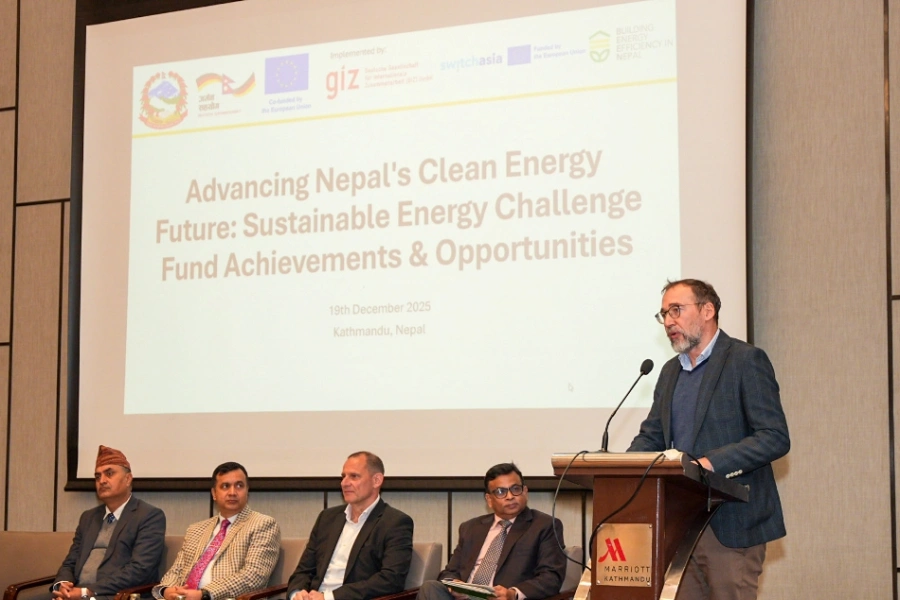
The issue of energy availability in Nepal has recently come to focus of public debate. As an essential aspect of economic activity and social growth, the continued lack of energy in Nepal has resulted in high environmental, health and economic costs to the country. Increasing the dependence on fossil fuel will simply aggravates the situation further. This could have an adverse effect on both the society and the economy. Therefore, it is of paramount importance to provide a sustainable supply of energy to power aspirations of prosperity as there is a high degree of correlation between energy use and economic development.
Nepal relies primarily on traditional sources of energy like oil and natural gas and until now, no proven deposits of these fuels are found within the country’s borders. Being one of the least-developed countries in the world, Nepal has a per capita energy consumption of approximately 15 GJ, far behind the world’s average consumption of approximately 70GJ per capita. Nepal has one of the world’s lowest rates of per capita electricity consumption, with an average of 86 kWh annually. Most of the country’s energy consumption is in the households, not in agriculture, industry and other commercial sectors.
In order to attain the double digit growth rates the National Planning Commission is aiming for, the demand for energy from all sectors will increase significantly. Industries like the tourism sector, manufacturing, food processing, transportation and a consumer based economy can be engines of development but they require a constant supply of cheap energy.
However, improving provision of and access to affordable energy is one of the most difficult tasks for a developing country to overcome. In Nepal, this can be done in three ways: by relocating rural populations to semi-urban or urban centres where electricity and other sources of energy is readily available. However, this requires structural changes to the economy, namely the shift from agriculture to one based on services and manufacturing. Improved access to energy alone cannot drive this process. The second option is to expand the electricity grids and make fuels available to rural communities though this requires huge economic investments. The third option is to harness local renewable sources of energy like biomass, hydro, solar, wind, etc.
ADB, UNDP join hands with AEPC to promote renewable energy

The first two approaches are unrealistic. A majority of the population are subsistence farmers and no industry can absorb them immediately into the urban economies while extending electricity grids to remote communities is impractical, given the geographical nature of the country, the decentralisation of communities and the immense cost that would come with this expansion.
This leaves us with the third option, the utilization of local resources in remote communities to generate electricity. As this electricity would be used for lighting and few electrical appliances, only smell levels of energy has to be generated at first, making the decentralized, local power generators a practical option.
Renewable sources of energy like solar, biogas, biomass and small scale hydro already account for the energy used in 15% of rural households. Nepal is rich in different types of renewable energy resources but with little promotion of them, many remote areas in mountainous regions are forecasted to be without electricity through 2017 or beyond.
Nepal has been expanding access to modern energy in rural areas for several years and further steps to expand coverage have already been taken. These steps include: enactment of a rural energy policy in 2006; development of a rural energy subsidy policy; establishment of rural energy funds and exemption from certain taxes, royalties, and licensing requirements for start up companies in the sector.
Nepalis annually invest around Rs. 1.5 billion in renewable energy to meet their power needs. This has created a renewable energy sector that now employs around 10,000 people in the more than 500 small and medium enterprises. It is a rapidly expanding sector, with a growth rate of around 10 percent per annum. Renewable energy technologies (RET) have created well paying jobs that has spurred local development. Improved access to energy has increased economic activities, raising income levels of communities previously starved of energy.
As around 80 percent of Nepalis depend on firewood for cooking and heating, increased use of renewable energy sources will reduce dependence on wood as a fuel source by more than 25 to 50 percent, preserving Nepal’s forests and reducing health problems associated with indoor air pollution. Empirical evidences shows a clear relationship between exposure to indoor air pollution (caused by the smoke from indoor fires) and occurrence of acute respiratory infection, chronic obstructive pulmonary diseases (COPD), cataract, asthma, low birth weight and lung cancer. With poor ventilation in most homes and years of inhaling the harmful smoke, it is no surprise that respiratory infections are the third leading cause of death amongst Nepalis.
Yet, there remain significant obstacles that have to be overcome to make renewable sources of energy a feasible option. The primary one is limited credit for investment in rural areas, particularly for small-scale technologies. Without monetary support, these industries will be unable to grow. Efforts have to be made to build the capacity of companies to design, manufacture, install and market these industries to investment, further enabling the sector’s growth. More effort to utilize renewable sources of energy on a national level also needs to made, whenever technically and financially feasible.
Continued investment in renewable energy will ensure industry growth, decrease dependency on fossil fuels by 30% to 40% by 2027 while creating an additional 50,000 jobs .A robust renewable energy sector with a strong domestic market entails optimal utilization of local resources and skills while opportunities to export Nepali renewable energy products and skills will also present itself. This will contribute positively to the Government’s Balance of Payment instead of the current scenario, where the government spends massive sums to import fuel.
In summary, effective utilization of renewable sources of energy to meet the current and future energy demand while reducing dependency on fossil fuels will need sustainable strategies.
For a decentralized electricity system generated by locally produced sustainable sources of fuel, the government, donor community, civil societies and the private sector has to be involved. Only with this can rural and remote parts of Nepal gain access to energy that is economically feasible, ecologically sound and with no health risks.
Pokhrel is Vice-chairman, National Planning Commission