The Republic Day is celebrated on 26 January every year with great pomp and show. [break]
The celebrations commemorate the day in 1950 when the constitution of independent India was promulgated.
The martyrdom of Mahatma Gandhi falls shortly after.
It has become a low-key affair in the country of Narendra Modis and Nitish Kumars.
In a show befitting its status as a country with one of the largest defense forces in the world, the Republic Day parade in New Delhi is dominated by the military.
Soldiers display their skills on motorcycles.

Latest wares of warfare are exhibited. Select ethnic groups in their distinctive costumes add color to the martial celebrations.
This year too, the Russian T-90 tanks rolled on New Delhi’s Rajpath (The King’s Way of the British Empire in India) as combat jet Tejas, advance Brahmos launcher system, fighter jets like Sukhois and Jaguars, and attack helicopter Mi-25 took part in the pageant. Chief Guest at the parade was Indonesian President Susilo Bambang Yudhoyono.
President Pratibha Patil, Supreme Commander of the Armed Forces, received the salute.
Sonia Gandhi was said to have been slightly indisposed.
At least that is how television commentators tried to explain her conspicuous absence from the show.
The way guests addressed each other was not audible to the viewers of direct telecast.
But their dresses more than made up for the loss.
Starched tunics, polished brass and all manner of headgears adorning security personnel appeared striking.
President Yudhoyono, dressed in an impeccable western suit, topped his attire with the trademark cap, which looks so much like a Bhadgaunle topi.
Vice President Hamid Ansari and Prime Minister Manmohan Singh were dressed in Sherwani, a variation of traditional Achakan that is now the ceremonial dress of India and Pakistan.
The once-famous Gandhi cap is on verge of extinction as even Khadi has now been privatized.
The pioneer of Aligarh Movement Sir Syed Ahmad Khan (1817-1898) popularized Sherwani among the Muslim gentry of North India.
He was suspicious of Indian independence and believed that interests of Muslims would be better served by cooperating with the British.
Aristocratic connotations of the dress got confirmed when the Nizam of Hyderabad, one of the richest man of his time, adopted it as a formal wear.
Muhammad Ali Jinnah discarded his Saville Row suits in favor of Sherwanis. Jawaharlal Nehru donned a modified version, a half-sleeved and shorter Sherwani that came to be known as Jawahar Coat in Hindi and Jwari Coat in Nepali.
However, it was his portrait in formal Sherwani, with a red rose in the
buttonhole, which became his trademark image.
Designers hold that there is not much indigenous about Sherwani -- it is merely an improvisation of Salwar Kameez, an attire characteristic of horse-riding warlike people of Central Asia -- transposed upon an altered Achakan and the British frock coat.
When Nehru and Jinnah adopted it as their ceremonial wear, the dress acquired its haloed status.
If iconic figures begin to don particular garb, it does not take long for the apparel to acquire the status of a national dress.
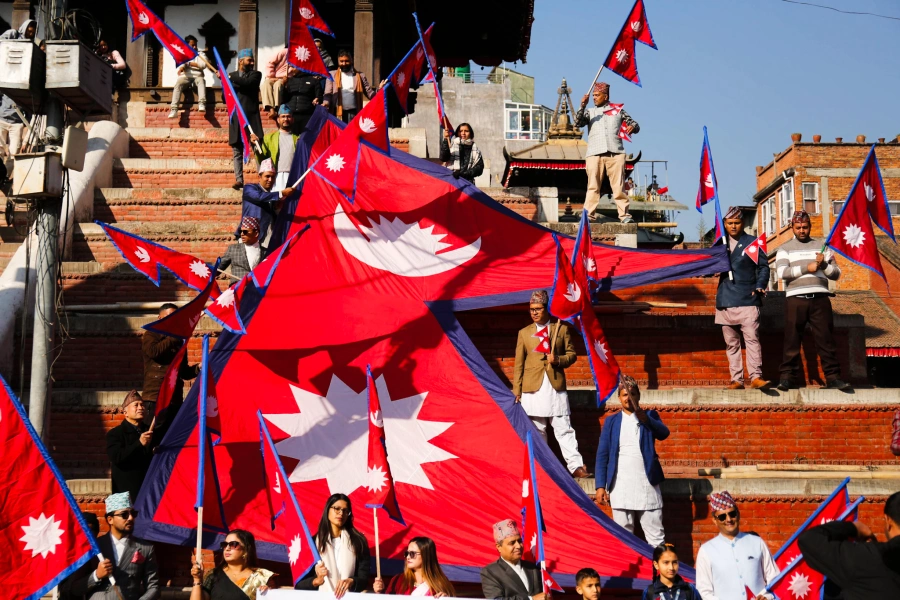
The Nepali national dress too is strange amalgamations of Uparna Vaishnav upper wear of Saurastra that has been transformed into Labeda or Daura, the Muslim Churidar that has become local Suruwal, a western coat, and black leather shoes.
Not everyone can carry off such a quixotic ensemble with élan. Strutting about in this decorous outfit, some members of the caretaker government resemble Chinese stuffed toys with fresh Japanese batteries powering their movements.
That is a digression though. The issue at hand is Sherwani, something that Mahatma Gandhi probably never wore.
This ‘half-naked faqir’ has become something of an embarrassment for Indians in their designer Achakans and solemn Sherwanis dreaming about the day when they would be judged by the clothes they wear.
The ‘half-naked faqir’ sobriquet owes its origin to Winston Churchill, perhaps one of the most militant defender of British Empire.
He once said of Gandhi, “It is alarming and also nauseating to see Mr Gandhi, a seditious middle temple lawyer, now posing as a fakir of a type well known in the east, striding half-naked up the steps of the viceregal palace, while he is still organizing and conducting a defiant campaign of civil disobedience, to parley on equal terms with the representative of the king-emperor.
” Churchill must have churned when the king-emperor himself, rather than his representative in India, had to entertain the same frugal visitor in his palace in London. When asked whether he felt uncomfortable in his humble Dhoti, topped with rough shawls for warmth, in front of the imperial majesty, Gandhi is reported to have replied, “Not at all. The king had enough for both of us.”
In contrast to the splendor of Republic Day, Martyrdom of Mahatma Gandhi four days later is a grim reminder that violence lurks in the mind of people that have not yet acquired the maturity to shoulder responsibilities of freedom.
On 30 January 1948, Nathuram Godse shot from point-blank range as the Mahatma fell with the chant of He Ram on the ground. He probably forgave his assassin before he breathed his last.
The law of independent India, however, were still British. Godse was hanged before the country got its own constitution.
Gandhi was one of the first to realize that poverty is the worst kind of violence.
However, it is loss, or perceived loss, of human dignity that propels people into adopting violent means of settling scores.
Her own bodyguards killed Indira Gandhi and a suicide bomber blasted Rajiv Gandhi into pieces.
Their failures and flaws apart, the mother died for the unity of India while her son became a victim of vengefulness of people scorned.
Jaffna Tamils paid a very heavy price for eliminating a scion of Nehru-Gandhi dynasty. However, the suicide bomber who blew herself up to kill Rajiv proved the point once again that the rage of the oppressed does not differentiate between past patrons, potential allies or probable foes.
Even when the Indian establishment is pretending to be the regional hegemon on the basis of its coercive power, elsewhere in the world its citizens are treated no differently from other South Asians.
Recently it was reported that Indian students of Tri-valley University in California were tied with radio collar in legs to monitor their movements.
Law enforcement agencies of US government have defended the decision of marking fellow human beings in the manner of animals of a wildlife reserve on security grounds.
Sherwanis or suits, people that lack the courage to challenge imperial powers often have to bear the indignity of being a subject race.
Sadly, like Christ-on-Cross forever, Mahatma Gandhi has been hanged millions of times after his death.
The portrait of the Mahatma is forced to bear witness to the excesses of government officials across the length and breadth of his country and in Indian embassies abroad.
His visage adorns the currency notes that have now acquired their own distinctive symbol.
It seems that if techies of Silicon Plateau at Bangalore or Hyderabad had their way, they would rather put a Gandhi in Sherwani on Rupee notes before making it fully convertible in the international currency market.
The most pathetic however are Mahatma’s statues in Indian cities where the upright man in his Dhoti, with a walking stick in hand, is made to stoop and watch helplessly as his beloved land marches from the dream of Gram Swaraj to the nightmare of urban dystopia.
Perhaps there is a lesson in this for aspiring leaders of Nepal.
If Pushpa Kamal Dahal and Upendra Yadav really want to be entertained in New Delhi like President Ram Baran Yadav or Premier Madhav Kumar Nepal, they should learn to don Labeda-Suruwal and never attempt to speak Hindi in private or public.
Imperialists love their supplicants in exotic attire, which mimic their tunic, without appearing to be an exact replica that may offend fine sensibilities of the master class.
Related story
Police detain Indian Congress leaders Rahul Gandhi and Priyanka...