

“A virtuous and generous person always bows;
where is the branch of a fruit-laden tree that does not bend?”
— Poet Laureate Lekhnath Paudyal
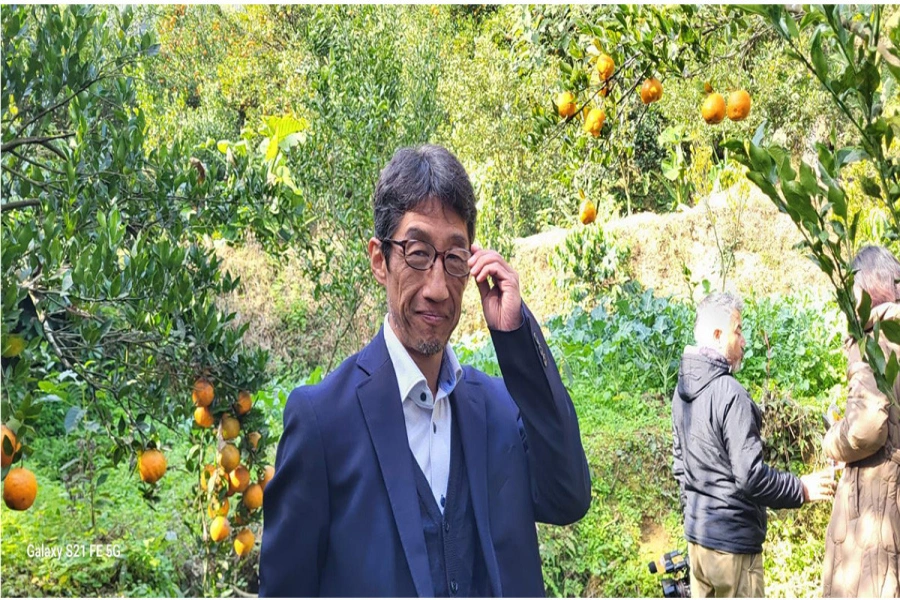
Those lines seemed to come alive on the face of Matsuzaki Mizuki.
In the hills of Syangja, orange orchards stood heavy with ripened fruit, their branches bending under abundance. Like those branches, Matsuzaki spoke to visitors with a gentle bow—free of formality, untouched by the arrogance of rank. There was no distance, no authority asserted—only quiet humility.
Standing beside him, it was hard to believe he was the Chief Representative of the Japan International Cooperation Agency (JICA) in Nepal. He felt more like a fellow traveller—someone who listens patiently and attentively to farmers speaking of soil, seasons, and survival. The bowed orange branches and his own demeanour reflected the same virtue: grace under abundance.
There was no performative seriousness on his face. Instead, his eyes carried warmth—familiar, almost reassuring. It is this simplicity and sincerity that distinguish Matsuzaki Mizuki from the usual image of a development leader.
When titles disappeared and the person emerged
About a month ago, a field visit to the Pokhara region brought together journalists, government officials, and technical experts. By designation, Matsuzaki was the most senior figure in the group. Yet throughout the journey, he neither led from the front as a “chief” nor commanded from behind.
He moved among everyone—engaging local residents in conversation, listening carefully to journalists’ questions, gazing out of the window with a soft smile, and occasionally humming light Japanese tunes that turned the long drive into something almost meditative.
Nepalis in Japan provide monetary aid to kidney patients

That journey planted a question that lingered long after it ended: what should leadership in development cooperation really look like?
BP Koirala’s words surfaced naturally: “Son, don’t try to be big—try to be good.” Matsuzaki seemed to embody that idea—a good person in a big position. Perhaps that is why he felt less like a leader and more like a human presence, grounded in empathy.
JICA and Nepal: a long companionship
The Japan International Cooperation Agency is no stranger to Nepal. Japan’s Official Development Assistance began in 1954 and reached Nepal in 1959. For nearly seven decades since, JICA has remained a quiet yet deeply committed companion in Nepal’s development journey.
Roads, tunnels, bridges, irrigation systems, schools, hospitals, agriculture, disaster management—there are few corners of Nepal’s development landscape untouched by JICA. Yet its defining strength lies beyond concrete and steel. JICA’s true investment has always been in people and institutions.
Volunteers who blend into society
Across Nepal’s villages, one sometimes encounters Japanese faces—dressed simply, cycling along dusty roads, notebooks in hand. They are JICA Overseas Cooperation Volunteers. They teach in classrooms, work alongside farmers in fields, and serve in health posts.
Learning the language takes time. Building relationships does not. They eat rice with Nepalis, celebrate festivals, and share grief and joy alike. This deep integration sets Japanese assistance apart. It is not the language of donors and recipients—it is the bond of companions.
From tunnels to trust
The Nagdhunga Tunnel Road and the Sindhuli Highway stand as recent symbols of this partnership. The Nagdhunga Tunnel, linking Kathmandu to Naubise, is more than a transport project—it is a statement of quality. Excavation challenged geology, water flow, and safety norms. Delays drew criticism. But the Japanese principle remained firm: better slow than unsafe; better delayed than unsustainable.
The Sindhuli Highway tells a similar story. Once feared as a “death road,” it is now the lifeline of eastern-central Nepal. Built with Japanese assistance, it shortened distances—not only on maps, but in minds. Trade expanded. Access to healthcare and education improved. Psychological barriers dissolved.
Japanese engineers spent years battling Nepal’s hills—learning, adapting, and teaching. That spirit of continuity persists under Matsuzaki’s leadership. Plans are already underway to rebuild flood-damaged sections of the road. Meanwhile, new initiatives to ease traffic in the Valley are progressing, with more projects in preparation.
Oranges of Syangja, fish of Begnas
JICA’s footprint is not limited to megastructures. In Syangja, technical support to orange farming has transformed livelihoods—improving disease management, boosting production, and strengthening market access.
Near Begnas Lake in Pokhara, a fish-farming project balances ecology, tourism, and income generation. It reflects a development philosophy rooted in harmony rather than extraction.
From volunteer to representative
Curiosity about Matsuzaki’s journey feels inevitable. His JICA story began in 1998 in the Philippines—as a volunteer. From there, it took him through Laos, Egypt, Yemen, and JICA’s headquarters in Tokyo. After leading education programmes in Africa, he now serves in Nepal.
Though trained in physics, he appears more interested in the human condition than in material equations. Perhaps that is why his seriousness never intimidates, and his smile never feels rehearsed.
The “Good Person” and Japan’s shadow
Bertolt Brecht’s The Good Person of Szechwan asks a timeless question: is it possible to remain good in this world? Observing Japanese cooperation in Nepal, one feels the answer may be yes—by seeking impact over profit, partnership over command, and sustainability over speed.
Matsuzaki Mizuki seems to embody that philosophy—not as an individual alone, but as a representative of an institutional ethic.
Japanese Official Development Assistance has now completed 70 years. Nepal stands as a valued partner in that journey. Under Matsuzaki’s leadership, JICA Nepal continues to anchor its vision of “leading the world with trust” firmly in Nepali soil.
His smile, his simplicity, and his quiet seriousness all convey one truth: development is not merely about structures—it is about relationships. And to sustain those relationships, we need good people.
May the shadow of Japan’s “good person” linger in Nepal for a long time to come.





-1200x560-1774606010.webp)


