- Dr Mahathir Mohamad
Either be a status quoist or be a change agent. This popular adage of one of the much coveted statesmen of our times bears this undertone. Dr Mahathir Mohamad, a former prime minister of Malaysia, dared to be a change agent in his 22 years of reign from 1981 to 2003 and turned Malaysia from a third world country into a high-tech manufacturing and financial hub. Economic growth averaged over 10 percent and living standards grew 20 fold, with poverty at par with the developed countries. For countries like Nepal, it is a wonder because we have wasted the same amount of post-1990 period in political bickering not even achieving a fraction of such socio-economic progress.
Nothing showcases leadership—or its absence—like a crisis. This is perhaps why leaders are so well known in countries that emerged from one or the other kind of conflict or political transition and later established themselves as stable and prosperous states. Many identify Nelson Mandela as the reason South Africa avoided bloodshed after apartheid, Lee Kuan Yew as an architect for pushing Singapore to a first world country in three decades, Luiz Inácio Lula da Silva as a hero for stabilizing Brazil´s hyper-inflation and making it an economic power in South America, and Paul Kagame as having made the difference in Rwanda after the genocidal killing of 1994. There are many others who have carved a niche in the list of world´s best statesmen and politicians. I often wonder, don´t our leaders deserve the same status?
From Constituent Assembly (CA) elections to the extension of its term to writing the constitution, our power-savvy political parties never took their tasks to the finish at one go. Even after more than three years since the CA elections, political scenario is as bleak as it was. The battle over leading the government and inter-party feuds permeate the political stalemate. If we look at the CA´s track record, it does not inspire much confidence. We have already spent Rs 1.45 billion of taxpayer´s money for salary and perks of the CA members but only to reward their underperformance. Maybe Nepal is one of those rare democracies in the world where legislators and politicians are being paid for non-delivery. Still fresh in our mind is the loss of more than six months over futile elections for the premiership. The CA barely met for 95 minutes last year. The figures for the CA´s productivity and the time wasted in disruptions, walkouts and sloganeering do not yet make a pretty picture for months ahead.
Good leaders must have the tenacity to just press on no matter how difficult the circumstances are. In fact, it is this quality that separates the good from the excellent. Everyone can lead well when circumstances are favorable but it is in the times of adversity that leaders are really tested.
Many challenges to constitution writing just pile up. From integration of the Maoists combatants to fixing forms of governance to restructuring the federal units, these thorny issues have remained untouched as they were three years ago. Service delivery is in a mess, rule of law is disrupted, corruption is widespread, impunity is intense, development is deadlocked and political accountability is at the lowest ebb. Constitution writing and conclusion of peace process has failed to make substantial headway even if the August 31 deadline is knocking on our doors. This pathetic imbroglio pushes us to ponder, are we destined to fail? Latest Failed States Index tells us that Nepal is in the "danger zone" of being failed as corruption, political deadlock, poor services, impunity, weak rule of law, among others, continue to plague us unprecedentedly.
Various queries haunt us today as everybody is wary of unaccountable politics. We pay taxes but live in rented rooms without basic amenities when our leaders live in posh bungalows. Our kids don’t get quality education, while their children study abroad. When average Nepali can´t afford basic medications and have to die of preventable diseases like cholera, our leaders fly abroad for medical treatment. When rural folks have to walk long distances just to get a few kilos of subsidized rice, our leaders lunch in star hotels and restaurants. When people have to travel in poor and unreliable public transports, our leaders travel in expensive SUVs. When people are losing life crossing rivers by tuins, our prime ministers distribute millions of rupees from the state exchequer to cling to power.
The list of painful dichotomy goes even longer. Popular frustration against politics had never been so intense. So is the case with political accountability. Its deficit was never so acute in the past. Parties have completely lost social contract with the electorate. They are losing their credibility and gradual loss of political accountability is posing a detrimental impact to our democratic transition. When trust in governance is questioned and public confidence in these political institutions become hollow, public frustration flourishes at the cost of democratic system itself. Political accountability in democracy is often measured by delivery and performance.
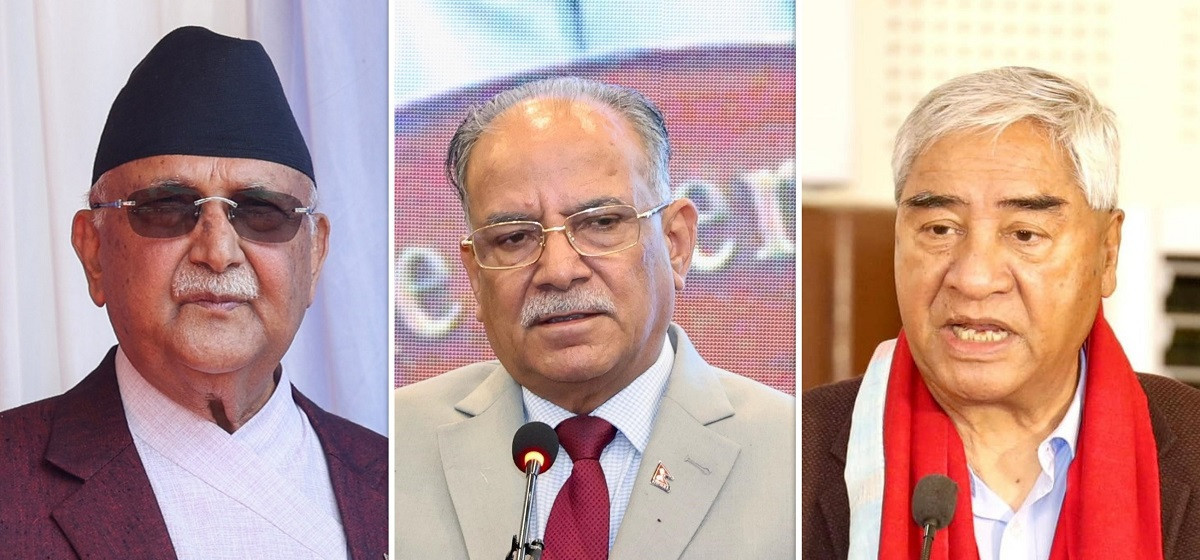
Society that loses trust in politics can flare up public rage as seen in London very recently because people´s moral awakening to the need for honesty and accountability in governance cannot be reversed. All of us know that it is accountability in politics that makes a difference in the status quo. As Nepal is at the most difficult time in political history, the level of accountability our Big Three parties show up in forthcoming days will decide how Nepal´s democratic transition will shape up—for better future or for worse. The Big Three must know that their sheer political rhetoric and mudslinging won´t not put them in the "safe zone" if constitution writing and peace process suffers irreparable setback. Frustratingly enough, no sooner had Prime Minister Jhala Nath Khanal stepped down, parties again began jockeying for power.
Just look at the southern neighboring state of Bihar today; it makes us envious. Once a state that hit headlines for all wrong reasons—caste politics, high crime rate, corruption, bad governance, low literacy, poor healthcare and a pathetic human development—Bihar is now catching global attention for its rapid, all-round progress. Nitish Kumar as chief minister has brought social and administrative order by strategically prioritizing crime control, administrative reforms, women´s participation in local governments, and improving quality of life through community-centered schemes in health, education and infrastructure.
Bihar is a success story right in Nepal´s vicinity. It proves that many leaders are not needed but one who is committed and selfless will be enough to bring in substantial changes. What Gokarna Bista and Dr Baburam Bhattarai did as ministers within a short span of time deserves heartfelt admiration. At least they tried to set new standards of professionalism and performance, and raised people´s spirits up. But the pity is that our political and governance system is so corrupt that such people get discouraged and cornered. See what happened to SP Ramesh Kharel after he tried to bring law and order in the capital? Thus, the system alone—be it federal or unitary or whatsoever—doesn´t ensure better governance unless it is managed by good and accountable leaders.
Good leaders must have the tenacity to just press on no matter how difficult the circumstances are. In fact, it is this quality that separates the good from the excellent. Everyone can lead well when circumstances are favorable but it is in the times of adversity that leaders are really tested. Therefore, our much-hyped consensus, a political cliché of new Nepal, will still remain elusive if our leaders continue to act as victors in a high-stake political scenario of Nepal with “winner takes all” mentality. Until then, our leaders will have tough times to emerge as brokers of peace, guarantors of stability and even catalysts for post-conflict growth in new Nepal. My humble plea to all our leaders, if you remember Dr Mahathir Mohamad´s popular epigram as a guiding principle, it will obviously encourage you to do better, and people don´t have to suffer from this endless cycle of unaccountable and shoddy politics.
pbhattarai2001@gmail.com
Related story
Enough is Enough is a movement for social justice


-1779178226.webp)