Karl Marx was more concerned with diagnosing or dismantling the existing system; his sketchy notion of building something anew in its place were given differing interpretations by Lenin, Stalin, Mao, Che Guevera, Pol Pot, Kim Il-Sung, Kanu Sanyal and Prachanda; mostly with consequences that the Sage of Highgate had failed to contemplate.
In Hindu mythologies, Ramayana narrates contests for supremacy with victory as the ultimate goal of all wars, which is, as Carl von Clausewitz has verbalized in a catchy phrase, merely continuation of politics by other means. The Mahabharata tells so many contradictory things all at once that only Lord Krishna is capable of deriving any generalized lesson from it. However, conspiracies and conflicts for the control of the state are two threads that bind stories within Mahabharata together. That could be the reason politicos, management gurus, and filmmakers love Mahabharata so much. People are mere spectators or victims of games elites play or wars they fight.
Mahatma Gandhi considered politics to be a process of creation of better human beings—an intoxicating mix of Plato, Aristotle, Balmiki and Ved Vyasa—living together in the virtuous state of Ram Rajya. The dream inspires many politicos; but most of them soon fall for the fatal allure of realpolitik.
It's sometimes baffling that Nepali politicos wrestle so much in the mud for so little when most of them know full well that they have very little capacity to loosen the stranglehold of the PEON over the apparatuses of the state.
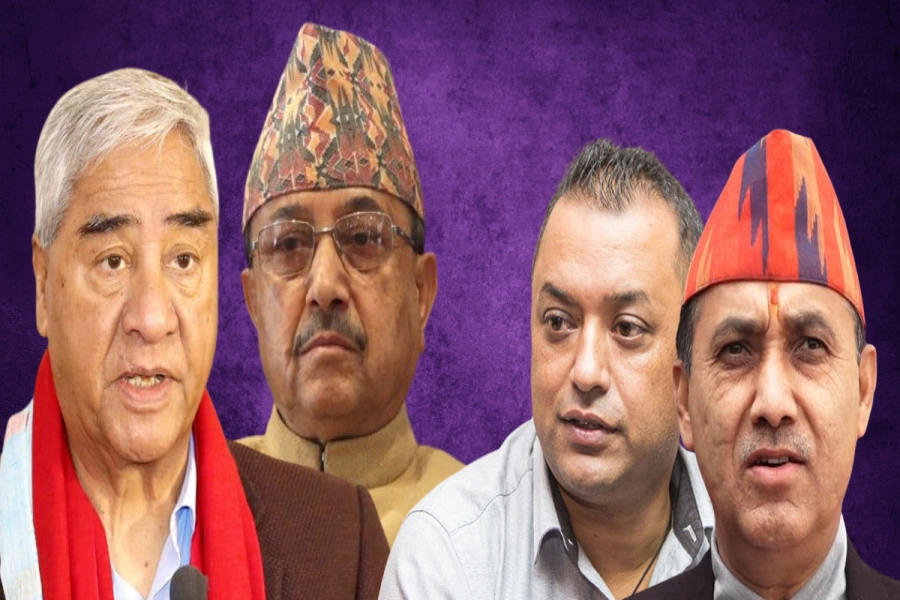
Theoretically, Marich Man Singh was an appointee of the reigning and ruling monarch during the fading days of authoritarian Panchayat regime. Premier Sushil Koirala is the head of government of a republic. In practice, it is difficult to find much difference between extent, style and limitations of their authority. Yet, Khadga Prasad Sharma Oli perhaps would not hesitate to do just about anything to relocate from Balkot to Baluwatar even though he currently exercises more de facto control than he could ever imagine enjoying as the de jure one. Part of the explanation for the clamor perhaps lies in the glamour of office, which have been the blessing as well as curse of Nepali politics.
Moving motives
Like all generalizations, categorization of generations too is fraught with perils of oversimplification. However, grouping offers a glimpse of complicated realities in tantalizing slices.
Premier SuKo is one of the last active politicos of the Veterans' Generation (Born before 1950s) that attached idealism with politics. Politics of the 1950s entailed endless struggle. That could be the reason a young SuKo dreamt of heading for Hollywood. Circumstances forced him to become the personal aide of Tulsi Giri in the Nepali Congress ministry. King Mahendra staged the royal-military coup, Giri ended up being a turncoat, and the Koirala surname turned out to be a debilitating disadvantage for nearly 30 years. It has been an unbeatable advantage since 1990s, but that's a different story.
Idealism perhaps loses its meaning when accidents of history propel unlikely successors in positions that they had never dreamt of. It is difficult to see what meaning Premier SuKo or his contemporaries of the VG age attach to continuing in politics.
It's not just Pushpa Kamal Dahal, most of his colleagues within UCPN (Maoist) or competitors in other parties belong to what can perhaps only be named as the Lost Generation (Born between 1950-1960) when values were in a flux, norms were yet to be reset and principles had fallen by the wayside. Growing up during the high noon of Shah Regime and Cold War rivalries in the 1960s and 1970s, only the politics of certainty offered any solace to the youths of the LG era.
Messrs Madhav Nepal, Jhalnath Khanal and Khadga Oli discovered the nationalism of Stalinism and Maoism. Baburam Bhattarai read Marx and contemplated mating Leninism with Leo Strauss. Sher Bahadur Deuba learnt the kind of socialism they teach you at London School of Economics, SOAS or Jawaharlal University closer home, which is to prepare ambitious individual of all classes for roles and responsibilities of faux-radical elites operating within the system. Pragmatism, with positive as well as negative connotations of the term, is the defining feature of LG politics. Little wonder, it's so contested: Giving in the process of give-and-take is extremely difficult if no higher goals are involved in negotiations.
For the Mahendramala Generation (Born between 1960 and 1970), there is nothing nobler than the preservation and promotion of self-interest. When they were growing up in the 1970s and 1980s, the decay of the diseased Panchayat system had already begun. Along with BP Koirala, idealism had died a slow death. Primacy of practical consideration often turns politics into a criminal enterprise that begins to attract desperados of all kinds. Even though political parties were allowed to exist with proscribed prefix during post-Referendum phase, they failed to gain traction in a field flattened and smoothened under the steamroller of royal-military ambitions. For most MG survivors, politics is a dirty word and politicians exist to be used for advancement of one's business or career goals.
Confusions of the Referendum Generation (Born between 1970 and 1980) have been even more confounding. They found out early on that the rewards of loyalty were high, voice entailed undesirable consequences, and exit was not an option open for everyone. However, NDS volunteers of Tribhuvan University in the countryside taught children to imagine. Literacy rose and expectations along with it. The People's Movement in 1990 was an uprising of frustrations and was carried mostly on the shoulders of early bloomers of RG cohort.
Parliamentary democracy was restored in 1990 and the so-called New Generation of Nepal came into existence. The Individualistic Generation (Born between 1990 and 2000) is still maturing while the Federal Democratic Republic Generation (Born after 2000) is yet to come of age. What are their dreams and aspirations? It's important to ask that question again and again because politics in the coming days will mostly be a playfield of their desires and ambitions.
Instant gratification
Every age thinks that the ones before them were too sanguine and the ones to follow lack all sense of responsibility. The ones passing judgment are often convinced that they had been revolutionaries while earlier ones were mostly reactionaries and succeeding ones are formed of either diehard conformists or hopeless anarchists. As far as generalizations go, these characterizations are likely to be met with a nod of agreement by most stalwarts of the VG, LG, MG or even RG era. Reality, however, is never so neat.
One thread that connects IG with its FDR cohort is their exasperation with conditions in the country. Whoever can, wants to get out at the very first opportunity. Hopelessness appears to be defining feature of the New Generation. There are honorable exceptions; biggest challenge before them is to raise confidence levels of their contemporaries. Nepal has many failings, but it's still a country where dreams haven't yet been proscribed. But dreams require some courage, and the conviction to convince others that they can be realized in this lifetime if only gratification is delayed for a while.
The VGs dreamt and a referendum had to held, which in effect delegitimized the very concept of the 'partyless' system. The LGs are still to decipher their own dreams, but they were effective in the restoration of parliamentary system. For good or bad, MGs helped establish and institutionalize supremacy of the market over the state. They continue to be primary propagandists of the libertarian order. As White Shirts (The Dabloos), they ceaselessly spread Red Scare with stale slogans of McCarthyism. The RGs are keeping the economy humming with their remittances, non-formal businesses and the NGO-industry.
Exceptional individuals make, break and remake rules; all the rest are quite content to merely follow the lead. The country needs to keep its ears open for voices of the IG and FDR youngsters. Without their energy, federalism with dignity, inclusion with justice, and democracy with full participation of all are unlikely to materialize anytime soon. The task is clearly cut out for them: Challenge the PEON or perish. History has to move on despite occasional backward loops.
Related story
Nepal Elections: A Call for Generational Shift