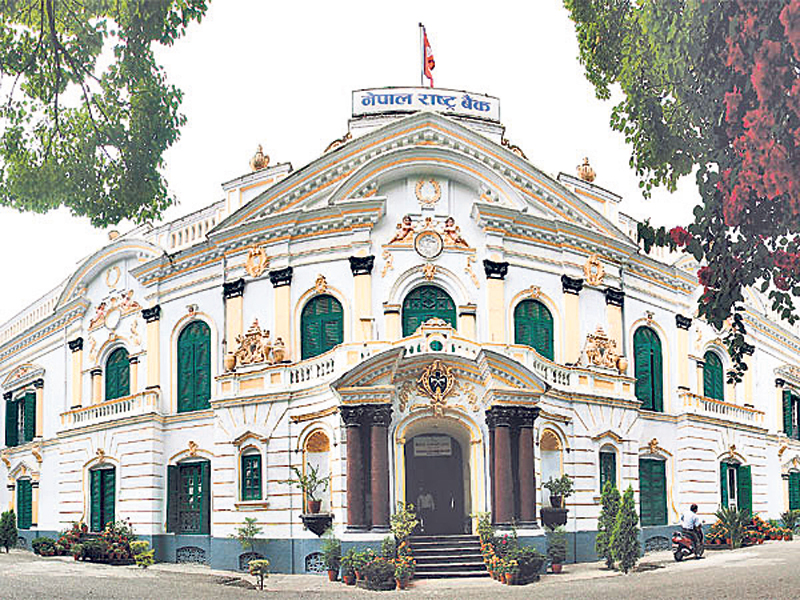
The central bank is yet to recover already matured fixed deposits of Rs 296 million from the troubled Gurkha Development Bank (GDB). It also has additional deposits of Rs 481.6 million in the same bank, which has closed down customer services since a month fearing "bank run", a term used to describe massive withdrawal by depositors.[break]
NRB also has another Rs 224 million in Nepal Share Markets and Finance (NSMF). Interestingly, the central bank recently axed NSMF´s executive chairman for engaging in irregularities and flouting banking law.
Though NSMF´s health appears fine in its financial statement the central bank doesn´t believe the statement and has asked for an independent due diligence assessment (DDA).
"Together, well over a billion rupee of the central bank is exposed to risks in these two troubled institutions," said an NRB official, requesting anonymity. "This makes NRB the second most vulnerable institutional depositor after the NA Welfare Fund," he told Republica.
But that´s not the full story. Officials at NRB themselves concede that finance companies are amongst the most vulnerable institutions in the market at present. This assessment has been proven right by the growing number of insolvencies among finance companies. What is bizarre is that NRB has invested in 51 finance companies.
Why is the regulator itself exposed to such high risk? What is the root cause of this malaise?
"It is the investment guidelines of NRB. The guidelines are lopsided and focus excessively on interest returns," said a senior NRB official.
NRB in its existing guidelines wants its investment department to focus on capital adequacy, other financial indicators and disciplinary track record while depositing its money. But at the same time it also says that deposits must be made in banks and financial institutions that offer the best interest return.
´´Best interest return" is a measure based on interest rate and safety of deposit. However, for the central bank officials concerned, "highest interest return" often takes precedence over safety issues.
"That is where the problem lies," said an NRB official.
Besides, the guidelines also say that officials concerned should make investments in such a way that it helps maintain liquidity in different categories of BFIs. "This is also a questionable approach. After all, is it prudent to maintain liquidity by distributing savings just like that?" asked the source.
Going by the guidelines, the central bank selects its savings institutions by calling bids and the BFIs that bid with the highest interest rates often bag the NRB deposits. During this process, officials do not even seek justifiable answers as to why the institutions quote much higher returns (than promised to the public). Nor do they question the viability of such quoted returns.
For instance, the troubled GDB had won NRB deposits by quoting interest returns of 13.76 to 13.96 percent per annum, whereas at the time of bidding it was offering interest returns of around 8 percent to general depositors of the same category.
Likewise, NSMF had quoted to NRB an annual interest rate of 14.15 percent, whereas the rate for the general public was barely above 10 percent. "Such a massive difference in rates quoted for NRB should have drawn the attention of NRB but it didn´t," said the source.
Just like the officials of other vulnerable institutional depositors senior NRB officials defend their investment decisions arguing that the financial condition of the troubled institutions was not bad then.
"And it is never easy to predict the pace at which financial health can deteriorate," NRB Spokesperson Bhaskar Mani Gyawali told Republica.
But the question is, if the regulator cannot predict it, who can?
Nonetheless, given the vulnerability seen in the sector lately, Gyawali agreed that the central bank might have to review its investment policy. "We have formed a committee to make suggestions in this connection," he said.
Related story
Revised interest rate corridor system introduced