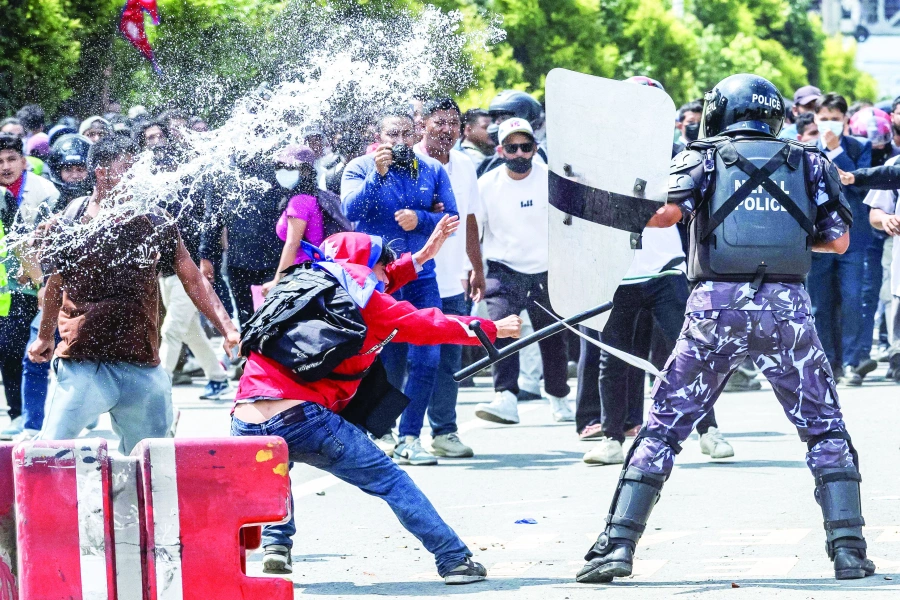
People are both worried and suspicious that the spirit of the Gen-Z movement may not be realised and that the sacrifice of 76 young people for transformation may ultimately go in vain. The Gen-Z leaders also do not seem very optimistic about materialising the agendas of transformation raised by the movement. These concerns are quite natural, as the country has suffered irreparable human and material losses for the sake of transformation.
Many people feel that Gen-Z should formally organise so that they can carry the spirit of the movement forward in the long run and help materialise its goals; otherwise, they may fall apart and the spirit of transformation may fade away over time. However, I do not believe this to be true. I believe that once Gen-Z is formally organised into an institution, it may fall into the trap of rigid organisational structures, where there is a strict organogram requiring individuals to follow the instructions of those in higher authority or positions. A loose network like Gen-Z does not teem with the strict structure of formally organised institutions.
Formally organised institutions do not always provide a free and fair environment for all members to express their opinions and thoughts on issues of concern in our context. If someone in a higher position senses that another member disagrees with his or her ideas, he or she may use authority to demoralise, sideline, or exclude that person from matters of concern and from the organisation itself. Such hierarchical structures create chaos and halt the common spirit of the people associated with the organisation. People do not feel free and fearless to review contested issues in terms of their merits and demerits. They often struggle to gain higher authority, power, and positions within the structure, sometimes by using unfair means. This is an open secret and is rampant in many organisations in the country. There are many other flaws in formally organised institutions compared to loose networks.
Therefore, Gen-Z should remain a loose nationwide network so that it does not fall into the trap of rigid organisational structures. Loose networks are lightly structured but strongly guided by the spirit they carry. Formally organised institutions often possess more power than loose networks; however, they tend to use this power first for the benefit and welfare of those associated with them, and only secondarily for the broader public. On this basis as well, loose networks are better able to connect with a large mass of people who share the same spirit and, in turn, work toward common goals.
Similarly, in the present context, Gen-Z has earned deep trust from a broad section of the public and is perceived as a fair and constructive force in the country. Civil society organisations are widely criticised for being aligned with and divided among political parties and their leaders. They are seen as failing to maintain neutrality and have lost public trust to function effectively as civil society in the country. In this context, Gen-Z and emerging social leaders have the opportunity to act as an independent civil society force. They are also regarded as an invisible power that exists everywhere to dispense justice to all, although sustaining this public trust over time remains a challenge.
That said, stating that Gen-Z shares the same spirit does not mean that its members do not have different missions to accomplish. Gen-Z members come from diverse political, social, cultural, regional, and religious backgrounds. In terms of political ideology, they range from the extreme left to the far right; however, they share certain basic and minimum features of a political and developmental transformation agenda. One may therefore assume that, in the future, they could divide along polar-opposite political and ideological lines. Such fragmentation would undoubtedly weaken them and lead them down an unproductive path. However, Gen-Z leaders are well aware, well-educated, and experienced in their respective fields of expertise. Therefore, I believe they will continue to uphold some basic and minimum common transformation agendas and emerge as a centrist force (middle force) in the country's political sphere.
Beauties, build the thick skin

The Government of Nepal has recently decided to form a Gen-Z Council, as stipulated in the 10-point agreement between representatives of the Gen-Z movement and the government. However, its organisational structure and jurisdiction have not yet been delineated. What kind of body will it be? Will it have an advisory role, or will it exercise executive power? Will it have structures at the subnational level? Perhaps the idea behind this decision is to keep the Gen-Z movement and its agendas vibrant and alive. However, there are suspicions about whether the upcoming government will take ownership of this council and carry forward its mission.
There has been an organisation in the country, namely the National Youth Council, since 2015, which appears similar to the proposed Gen-Z Council. It was established on Falgun 19, 2072 B.S., under the provisions of the National Youth Council Act, 2072. Its objective is “to prepare capable citizens for building a prosperous nation by ensuring the rights, interests, protection, and promotion of youth. The Council also aims to empower young people and engage them in processes ranging from policy formulation to implementation, thereby integrating them into the mainstream of national development.”
Given this existing government structure, whatever form the Gen-Z Council may take, it is likely to conflict with or duplicate the jurisdiction and functions of the National Youth Council. The formation of multiple bodies with similar or overlapping mandates may not be useful; rather, it may create institutional redundancy, administrative complications, and inefficiencies in service delivery and smooth functioning.
Many people believe that the Gen-Z spirit and reform agendas will vanish over time. This may prove true, as has more or less been the case in many countries that witnessed Gen-Z movements that toppled contemporary governments. Such outcomes are likely if Gen-Z aspirations and agendas are not carried forward by self-help Gen-Z groups backed by independent individuals.
Initially, many characterised the Gen-Z movement in Nepal as leaderless and noted that it possessed the trait of “fragility of representation.” Of course, this is an inherent feature of such spontaneous movements, which often emerge as an overflow of deep frustration and suppressed sentiments that erupt suddenly. As mentioned earlier, this fragility of representation also has its strengths. People associated with such movements are not guided by a pre-set mission; rather, they are united by a common spirit. A spirit does not die, whereas a mission may conclude once it is accomplished.
In the Nepali context, this feature of fragile representation in the leadership of the Gen-Z movement has provided a unique strength that binds Gen-Z members and emerging leaders across the country. They share the same spirit and have united to push reform agendas forward collectively. I believe this spirit will endure in the long run. It does not necessarily need to fall under the formal processes of an organisation, which are often cumbersome and hierarchical.
Therefore, it is not accurate to say that the Gen-Z movement in Nepal and the reform agendas it has put forward will fade away. Gen-Z members may be loosely connected structurally, but they are strongly united by a shared spirit. In our context, Gen-Z represents an amalgamation of individuals from the Gen-Z age group and emerging leaders from diverse social, cultural, political, business, civil society, and development sectors. They are relatively financially independent and politically aware. However, some individuals appear to be influenced by ultra-left or ultra-right political ideologies. These groups constitute only a negligible portion. The majority represent a “middle force” that accepts the fundamental features of the prevailing Constitution of Nepal. This middle force will contribute to the country's prosperity and sustainable peace.