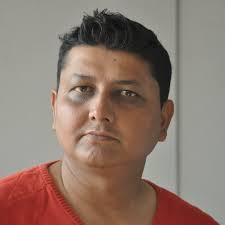
One day, he decided to leave the job at the newspaper and was stricken with the idea of “saving the world.” Thus began his travels to the most war-ravaged zones on the earth where human rights is at risk and bombs, grenades and bullets have become an everyday reality.[break]
“I’ve seen soldiers shake and friends being ripped apart. It’s not a pretty sight,” says Franklin who has witnessed five wars over the course of his career.

Keshab Thoker
A multilingual individual, he is fluent in English, Turkish, Arabic, French, and Spanish. Apart from being a renowned investigative reporter, he is also a trainer and teacher of journalism. He has been to many countries, training and teaching journalists from diverse social, academic, cultural and lingual backgrounds. As an investigative war reporter, one is always at an advantage when one has command of many languages when one needs to squeeze out of a tricky situation.
“I once had to pretend that my friend was an ambassador and that I was his companion to enter a particularly risky zone. My friend had no clue regarding what was happening and could do nothing but nod. We were almost shot,” he says with a perfectly smooth face and a calm sip of Nepali chiya.
Franklin, who has even suffered a slight hearing loss due to the blasts during one of his adventures, believes that calmness is the best antidote to any kind of turbulence. For someone who has witnessed wars, deaths and disasters of the greatest possible magnitude, Franklin displays a blatant disapproval and fear of extreme sports. He is unsure about their safety quotient and is not a big fan of throwing oneself off a cliff, for instance.
“Accidents don’t happen with a prior notice. There is always a first time, you know,” he comments with a perfectly solemn face.
Franklin, who is full of daredevil stories of his forty-year career, considers Nepal a perfect place for a present-day journalist to be in, considering its cultural diversity, social multiplicity and constant political upheavals. He, however, thinks that like every other field, journalism too needs more participation from women. He has been to countries like Saudi Arabia where even today there are some parts where women cannot be in the same building as men. Female journalists talk only to females. And Franklin had to train them from another building with the help of a microphone.
“No country can prosper without equal participation from its female citizens. And especially in a crucial field like media and journalism, women’s participation is really important,” he says.
Franklin was recently in Kathmandu for training Nepali journalists. One late Friday afternoon, he talked to The Week’s Nitya Pandey about his life as a journalist, trainer and traveler, and his ideas on the importance and methodolog
How has the experience with Nepali journalists been like for you during the training?
They literally stole my heart. They are so sharp, bright and enthusiastic. They are so willing to learn. These young people have a good understanding of their country’s situation. I’m really impressed with their performance during the training. They were so receptive to my instructions. All I did was provide them with a good pair of shoes. They are a smart lot with good hearts. I believe they are capable of choosing their direction now.
What do you really mean by investigative journalism which has been one of your major fortes throughout your career?
Journalists are tellers of real life stories. Investigative journalism helps them get the best possible stories. There’s so much yet to be told which would give the mass a better understanding of the world around them. Investigative journalism isn’t sensationalizing news to make it sellable. It’s actually the most credible form of journalism. It explains even those stories that people don’t want to be told. It not just exposes the problem but also looks for answers. It sends a strong message to the people about what’s happening and what needs to be done. The recent news about Nepali workers suffering in Qatar is one excellent example of investigative journalism.
You’ve worked in so many countries that are completely different from your own. How do you prepare yourself?
That’s the most demanding and exciting part about being a journalist. You go out of your comfort zone to see different places and meet different people. Every new country and each new assignment is an equal challenge that requires thorough research. Citizen journalists come to my aid during these moments. These people are bloggers who may or may not be journalists by profession. Nevertheless, they are crucial when it comes to understanding a particular country or situation because they are the voice of the people. Reading blogs is like reading lives and realties of a particular space and context.
What, in your experience, are the most important qualities that a journalist should possess?
Today’s journalists should be in constant touch with the social media because that’s the best way to keep yourself up to date with things. Another important quality is to keep asking questions until you get satisfactory answers. Finally, the most important thing is unbiased reporting. A journalist should always keep himself/herself above the boundaries of religion, class and countries. You should be able to present stories of kings as well as paupers with equal clarity, certainty and objectivity. Journalists all over the world should bring out the sentiments and hues of humanity.
Related story
Mr Speaker, Either Prove or Apologize!