

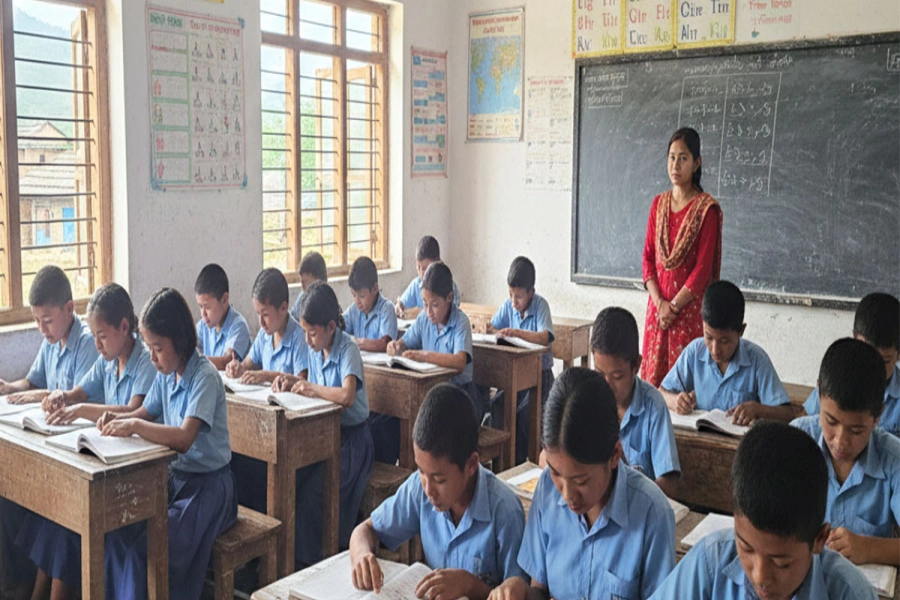
My recent experience of storytelling was an eye opener. I wanted to introduce the stories from Panchatantra to some children. I remember reading somewhere that Panchatantra was taught to children in olden times because it is considered nīitiśāsastra. Niīti means wise conduct of life, and śāsastra means a technical or scientific treatise; thus a nīitiśāsastra is a treatise on human conduct. In those days, kings and noblemen provided education to their sons through such stories. The children learned war tactics, diplomacy and the nitty-gritty of the day-to-day affairs of the state from these stories. Each story in Panchatantra is simple but contains a lot of depth, and can be easily related to real life situations. One particular story became the fodder for my experiment with children of fourth and fifth grades. At a time when the country is facing imminent polarization on ethnic lines, I wanted to see if I could use a simple story to give a complex message. As I was telling the story, my mind was working double time, thinking of ways to make it more interesting.

PHOTO: DOTELLFESTIVAL.ORG
The story emphasized the principle of “united we stand, divided we fall”. In the story, an old man talks about how a single stick is weak and breakable, but a bunch of sticks are formidable when tied together in a bundle. I finished the story, and the kids pretended to like it for my sake. It was a regular moral-story that they had heard many times before from their parents and grandparents. Just for the heck of it, I decided to ask them a few questions. “Do you have any questions about it? Can you see it in a different way? Can you find any similarities to real life situations in the story?” And this time their response was not so bland. I did not realize that my questions had opened a Pandora’s Box.
One fifth grader asked: “Is this true for human beings as well?” This was just the beginning of a very interesting and stimulating interaction that was to follow. “What do you think?” I asked back, “Let’s find out!” Suddenly the children were animated and excited. “Yes, yes, let’s!” said they enthusiastically.
“Suppose each person is a stick”, I said. Now each kid stood separately and I tackled them individually. “Not fair, not fair, you can’t do that to us,” they all yelled together. They saw that I could overpower them easily. “Why don’t you all stand together and we repeat the action?” I suggested next. They realized that when combined together, they could overpower me. This activity made the story fun. The story’s message was clearer this way, and their smiles told me, “Now we know what it means!”
I was glad that the children had drawn the right conclusions from the story, and along with them, I too had learned an important lesson that we generally tend to brush aside. But I could feel that something was bothering them. I had not expected children so young to be agitated by a story. I ventured forth and asked them what was bothering them. I was totally taken back by their response. Their concerns and questions were related to the demands made by various political parties for states with ethnic identities, a question that has already created some tensions between various ethnic groups. The children’s concerns intrigued me. I was utterly tongue-tied, hence I put forth my questions to them. “Does anyone even understand that these demands are making us weak and vulnerable, and that we are gradually losing our identity as Nepalis? Do the politicians even care what happens to Nepal?”
Then there was one fifth grader who looked very puzzled. I tried to find out what was bothering him. Very slowly he said, “I don’t understand why Nepali people are thinking in terms of little pockets when the whole world is becoming a global village. Are we moving forward or being pushed back? I think we fail to even realize how easy it’s going to be for our neighbors to exploit this situation”. I was surprised at his reaction. After his outburst, I wanted to prod a bit. “What do the neighbors have to do with it?” I asked. The child said, “Neighboring countries are no different from neighbors near the house, who will bribe you to get family information, find your weaknesses, and then even blackmail you or try to overpower you.” I was surprised to find such thinking in a ten-year-old. Yes, even fourth and fifth graders understand simple math.
Now it was another child’s turn. She seemed to be slightly disappointed: “I think our leaders don’t actually care about Nepal, they only care about themselves. Is that going to help us? If we have these ethnic states, will my best friend (who is of a different ethnicity) be able to live here?” And finally, she ended with “who wants an ethnic state anyway? We don’t want it. We belong to the new generation, where everyone is equal. That’s what we are taught in school. That’s what our parents teach us. So why are the leaders propagating such conflicting ideas, when the world is gradually becoming seamless? We should be united instead!”
I, for one, had a hard time explaining to the little kids what exactly the leaders were looking for when they raised the issue of ethnic identity. I ultimately failed in my explanation. There was no way I could explain away the frustrated responses of the children after the detailed discussion of a Pachatantra story and its implications on real life. I had never thought that a simple story from Panchatantra would spark such an interaction. I left the classroom with a promise of finding answers to their questions the next time I visited them.
Even after I left, one child’s statement kept ringing in my mind, “After all, all these leaders are going to die in 20 or 30 years. For whom do they want a divided nation? We don’t want such division!” This got me thinking. If the children don’t want it, then what is the purpose of creating states based on ethnicity? Has anyone even thought about what the children of this country want?
The author is an education specialist, consultant and author of several children’s books
usha@pokharel.net
Related story
Europa League title would be fitting farewell for Chelsea's Haz...









-1200x560-1774606010.webp)


